MCQ
Einstein's mass-energy relation is :
  • A
    $E = m c$
  • B
    $E =m c^2 / 2$
  • $E = m c ^2$
  • D
    $E = m / c$

Answer

Correct option: C.
$E = m c ^2$
C

Need a full question paper?

Generate a complete, print-ready paper with questions like this in minutes — across 16+ boards, with answer keys.
Start Generating Free

Similar questions

In a coaxial, straight cable, the central conductor and the outer conductor carry equal currents in opposite directions. The magnetic field is zero:
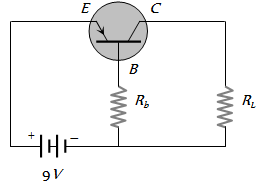
In a transistor circuit shown here the base current is $35 mA$. The value of the resistor $R_b$ is
There is no couple acting when two bar magnets are placed coaxially separated by a distance because(a) There are no forces on the poles(b) The forces are parallel and their lines of action do not coincide(c) The forces are perpendicular to each other(d) The forces act along the same line


In a biprism experiment, by using light of wavelength 5000 Å, 5 mm wide fringes are obtained on a screen 1.0 m away from the coherent sources. The separation between the two coherent sources is (a) 1.0 mm(b) 0.1 mm(c) 0.05 mm(d) 0.01 mm
       
A body is suspended from a spring balance kept in a satellite. The reading of the balance is $W_{1 }$when the satellite goes in an orbit of radius $R$ and is $W_2$ when it goes in an orbit of radius $2R.$
The acceleration of the moon just before it strikes the earth in the previous question is :
When no current is passed through a conductor:
Electric field and magnetic field in Thomson mass spectrograph are applied (a) Simultaneously, perpendicular(b) Perpendicular but not simultaneously(c) Parallel but not simultaneously(d) Parallel simultaneously
   
   
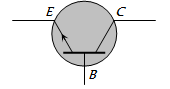
The symbol given in figure represents
Assertion  : The electrical conductivity of earth's atmosphere decreases with altitude. 
Reason      :  The high energy particles (i.e. ?-rays and cosmic rays) coming from outer space and entering our earth's atmosphere cause ionisation of the atoms of the gases present there and the pressure of gases decreases with increase in altitude.(a) If both assertion and reason are true and the reason is the correct explanation of the assertion.(b) If both assertion and reason are true but reason is not the correct explanation of the assertion.(c) If assertion is true but reason is false.(d) If assertion is false but reason is true.