MCQ
Electric conduction in a semiconductor takes place due to:
- AElectrons only.
- BHoles only.
- CBoth electrons and holes.
- DNeither electrons nor holes.
Generate a complete, print-ready paper with questions like this in minutes — across 16+ boards, with answer keys.
Dark lines on solar spectrum are due to
|
(a) Lack of certain elements |
|
(b) Black body radiation |
|
(c) Absorption of certain wavelengths by outer layers |
|
(d) Scattering |
The wavelengths involved in the spectrum of deuterium  are slightly different from that of hydrogen spectrum, because
|
(a) The attraction between the electr on and the nucleus is different in the two cases |
|
(b) The size of the two nuclei are different |
|
(c) The nuclear forces are different in the two cases |
|
(d) The masses of the two nuclei are different |
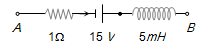
The network shown in the figure is a part of a complete circuit. If at a certain instant the current i is 5 A and is decreasing at the rate of  then
then  is
is
|
(a) 5 V |
(b) 10 V |
(c) 15 V |
(d) 20 V |
Two ions having masses in the ratio 1 : 1 and charges 1 : 2 are projected into uniform magnetic field perpendicular to the field with speeds in the ratio 2 : 3. The ratio of the radii of circular paths along which the two particles move is
|
(a) 4 : 3 |
(b) 2 : 3 |
(c) 3 : 1 |
(d) 1 : 4 |
The dual nature of light is exhibited by
|
(a) Photoelectric effect |
(b) Refraction and interference |
|
(c) Diffraction and reflection |
(d) Diffraction and photoelectric effect |