MCQ
Electric current is due to drift of electrons in:
- AMetallic conductors
- BSemiconductors
- CBoth (a) and (b) above
- DNone of the above
Explanation:
When an electric field is applied across the metallic conductors the randomly moving electrons are subjected to electrical forces along the direction of the field. Due to this field, the electrons do not give up their randomness of motion, but they will be shifting towards higher potential. That means the electrons will drift towards higher potential along with their random motions.
In semiconductors, in addition to electrons, the travelling vacancies in the valence-band electron population (called 'holes'), act as mobile positive charges and are treated as charge carriers. Electrons and holes are the charge carriers in semiconductors.
Hence, electric current is due to drift of electrons in metallic conductors.
Generate a complete, print-ready paper with questions like this in minutes — across 16+ boards, with answer keys.
Electric charges q, q, -2q are placed at the corners of an equilateral triangle ABC of side l. The magnitude of electric dipole moment of the system is
|
(a) ql |
(b) 2ql |
(c) |
(d) 4ql |
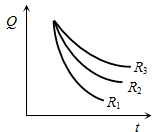
Three identical capacitors are given a charge Q each and they are then allowed to discharge through resistance R1, R2 and R3. Their charges, as a function of time shown in the graph below. The smallest of the three resistance is
|
(a) R3 |
(b) R2 |
(c) R1 |
(d) Cannot be predicted |
A 5℃ rise in temperature is observed in a conductor by passing a current. When the current is doubled the rise in temperature will be approximately
|
(a) 16 ℃ |
(b) 10 ℃
|
(c) 20 ℃ |
(d) 12 ℃ |
A uniform wire of 16 Ω is made into the form of a square. Two opposite corners of the square are connected by a wire of resistance 16 Ω. The effective resistance between the other two opposite corners is
|
(a) 32 Ω |
(b) 20 Ω |
(c) 8 Ω |
(d) 4 Ω |
An experiment is performed to find the refractive index of glass using a travelling microscope. In this experiment distances are measured by:
