MCQ
Electric lines of force about a negative point charge are:
  • A
    Circular anticlockwise.
  • B
    Circular clockwise.
  • Radial, inwards.
  • D
    Radial, outwards.

Answer

Correct option: C.
Radial, inwards.

Need a full question paper?

Generate a complete, print-ready paper with questions like this in minutes — across 16+ boards, with answer keys.
Start Generating Free

Similar questions

In an astronomical telescope in normal adjustment a straight black line of length $L$ is drawn on inside part of objective lens. The eye-piece forms a real image of this line. The length of this image is $I$ . The magnification of the telescope is
A parallel monochromatic beam of light is incident normally on a narrow slit. A diffraction pattern is formed on a screen placed perpendicular to the direction of incident beam. At the first maximum of the diffraction pattern the phase difference between the rays coming from the edges of the slit is
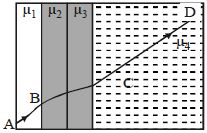
A ray of light passes through four transparent media with refractive indices $μ_1$, $μ_2$, $μ_3$ and $μ_4$ as shown in the figure. The surfaces of all media are parallel. If the emergent ray $CD$ is parallel to the incident ray $AB$, we must have
Assertion : Cyclotron is a device which is used to accelerate the positive ion.
Reason : Cyclotron frequency depends upon the velocity.
In Young's double slit experiment the intensity of the maxima is $I$. If the width of each slit is doubled, the intensity of the maxima will be:
The negative of the work done by the conservative internal forces on a system equals the change in:
In a transistor circuit the emitter-base circuit of a $n-p-n$ transistor is always
When radiation is incident on a photoelectron emitter, the stopping potential is found to be $9$ volts. If $e/m$ for the electron is $1.8 \times {10^{11}}\,C\,k{g^{ - 1}}$ the maximum velocity of the ejected electrons is
Assertion : Magnetism is relativistic.
Reason : When we move along with the charge so that there is no motion relative to us, we find no magnetic field associated with the charge.
Two plane mirrors are placed parallel to each other at a distance $L$ apart.$A$ point object $O$ is placed between them, at a distance $L / 3$ from one mirror. Both mirrors form multiple images. The distance between any two images cannot be