MCQ
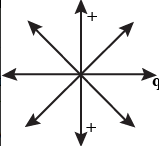
Electric lines of force about a positive point charge are:
  • Radially outwards.
  • B
    Circular clockwise.
  • C
    Radially inwards.
  • D
    Parallel straight lines.

Answer

Correct option: A.
Radially outwards.
Electric lines of force about a positive point charge are always radially outwards.

Need a full question paper?

Generate a complete, print-ready paper with questions like this in minutes — across 16+ boards, with answer keys.
Start Generating Free

Similar questions

Which of the following statement is true
A piece of fuse wire melts when a current of $15\, ampere$ flows through it. With this current, if it dissipates $22.5\, W$, the resistance of fuse wire will be .............. $\Omega$
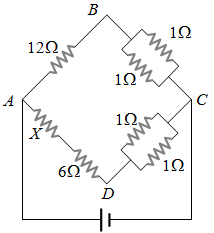
For what value of unknown resistance X, the potential difference between B and D will be zero in the circuit shown in the figure
A slit of width $a$ is illuminated by white light. For red light ($\lambda = 6500 \;\mathring A$), the first minima is obtained at $\theta = {30^o}$. Then the value of $a$ will be
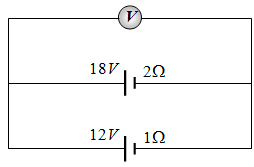
Two batteries, one of emf 18 volts and internal resistance 2Ω and the other of emf 12 volt and internal resistance 1 Ω, are connected as shown. The voltmeter V will record a reading of

Assertion : Goggles have zero power.

Reason : Radius of curvature of both sides of lens is same.
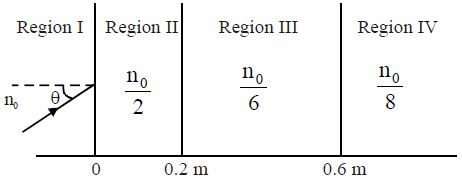
A light beam is traveling from Region $I$ to Region $IV$ (Refer Figure). The refractive index in Regions $I, II, III$ and $IV$ are ${n_o},\frac{{{n_o}}}{2},\frac{{{n_o}}}{6}$ and $\frac{{{n_o}}}{8}$, respectively. The angle of incidence $\theta$ for which the beam just misses entering Region $IV$ is figure
If a current I given by ${I_0}\sin \,\left( {\omega \,t - \frac{\pi }{2}} \right)$ flows in an $ ac $ circuit across which an ac potential of $E = {E_0}\sin \omega \,t$ has been applied, then the power consumption P in the circuit will be
Two stars situated at distances of $1$ and $10 $ light years respectively from the earth appear to possess the same brightness. The ratio of their real brightness is
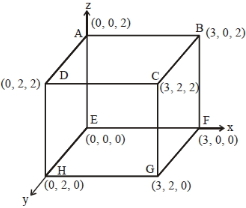
An electric field $\overrightarrow{\mathrm{E}}=4 \mathrm{x} \hat{\mathrm{i}}-\left(\mathrm{y}^{2}+1\right) \hat{\mathrm{j}}\; \mathrm{N} / \mathrm{C}$ passes through the box shown in figure. The flux of the electric field through surfaces $A B C D$ and $BCGF$ are marked as $\phi_{I}$ and $\phi_{\mathrm{II}}$ respectively. The difference between $\left(\phi_{\mathrm{I}}-\phi_{\mathrm{II}}\right)$ is (in $\left.\mathrm{Nm}^{2} / \mathrm{C}\right)$