MCQ
Electric lines of force:
- AExist everywhere.
- BExist only in the immediate vicinity of electric charges.
- CExist only when both positive and negative charges are near one another.
- DAre imaginary.
Generate a complete, print-ready paper with questions like this in minutes — across 16+ boards, with answer keys.
A battery is connected between two points A and B on the circumference of a uniform conducting ring of radius r and resistance R. One of the arcs AB of the ring subtends an angle θ at the centre. The value of the magnetic induction at the centre due to the current in the ring is
|
(a) Proportional to 2(180° - θ) |
(b) Inversely proportional to r |
|
(c) Zero, only if θ = 180° |
(d) Zero for all values of θ |
Average energy stored in a pure inductance L when a current i flows through it, is
|
(a) |
(b) |
(c) |
(d) |
In the circuit shown in the figure, the current through

| (a) The 3 W resistor is 0.50A |
(b) The 3 W resistor is 0.25 A |
|
(c) The 4 W resistor is 0.50A |
(d) The 4 W resistor is 0.25 A |
Two long straight wires are set parallel to each other. Each carries a current i in the same direction and the separation between them is 2r. The intensity of the magnetic field midway between them is
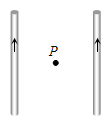
|
(a) |
(b) 4 |
(c) Zero |
(d) |


