MCQ
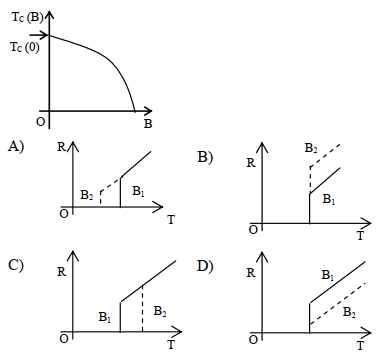
Electrical resistance of certain materials, known as superconductors, changes abruptly from a nonzero value to zero as their temperature is lowered below a critical temperature $T_c(0)$. An interesting property of superconductors is that their critical temperature becomes smaller than $T_c(0)$ if they are placed in a magnetic field, i.e., the critical temperature $T_c(B)$ is a function of the magnetic field strength $B$. The dependence of $T_c(B)$ on $B$ is shown in the figure. $Image$

$1.$ In the graphs below, the resistance $\mathrm{R}$ of a superconductor is shown as a function of its temperature $\mathrm{T}$ for two different magnetic fields $\mathrm{B}_1$ (solid line) and $\mathrm{B}_2$ (dashed line). If $\mathrm{B}_2$ is larger than $\mathrm{B}_1$ which of the following graphs shows the correct variation of $\mathrm{R}$ with $\mathrm{T}$ in these fields?

MCQ $Image$

$2.$ A superconductor has $T_C(0)=100 \mathrm{~K}$. When a magnetic field of 7.5 Tesla is applied, its $\mathrm{T}_{\mathrm{c}}$ decreases to $75 \mathrm{~K}$. For this material one can definitely say that when

$(A)$ $\mathrm{B}=5$ Tesla, $\mathrm{T}_{\mathrm{c}}(\mathrm{B})=80 \mathrm{~K}$

$(B)$ $\mathrm{B}=5$ Tesla, $75 \mathrm{~K}<\mathrm{T}_{\mathrm{c}}(\mathrm{B})<100 \mathrm{~K}$

$(C)$ $\mathrm{B}=10 \mathrm{Tesla}, 75 \mathrm{~K}<\mathrm{T}_{\mathrm{c}}<100 \mathrm{~K}$

$(D)$ $\mathrm{B}=10$ Tesla, $\mathrm{T}_{\mathrm{c}}=70 \mathrm{~K}$

Give the answer question $1, 2$
  • $(A,B)$
  • B
    $(B,C)$
  • C
    $(A,D)$
  • D
    $(B,D)$

Answer

Correct option: A.
$(A,B)$
a
$1.$ Larger the magnetic field smaller the critical temperature.

Need a full question paper?

Generate a complete, print-ready paper with questions like this in minutes — across 16+ boards, with answer keys.

Start Generating Free

Similar questions

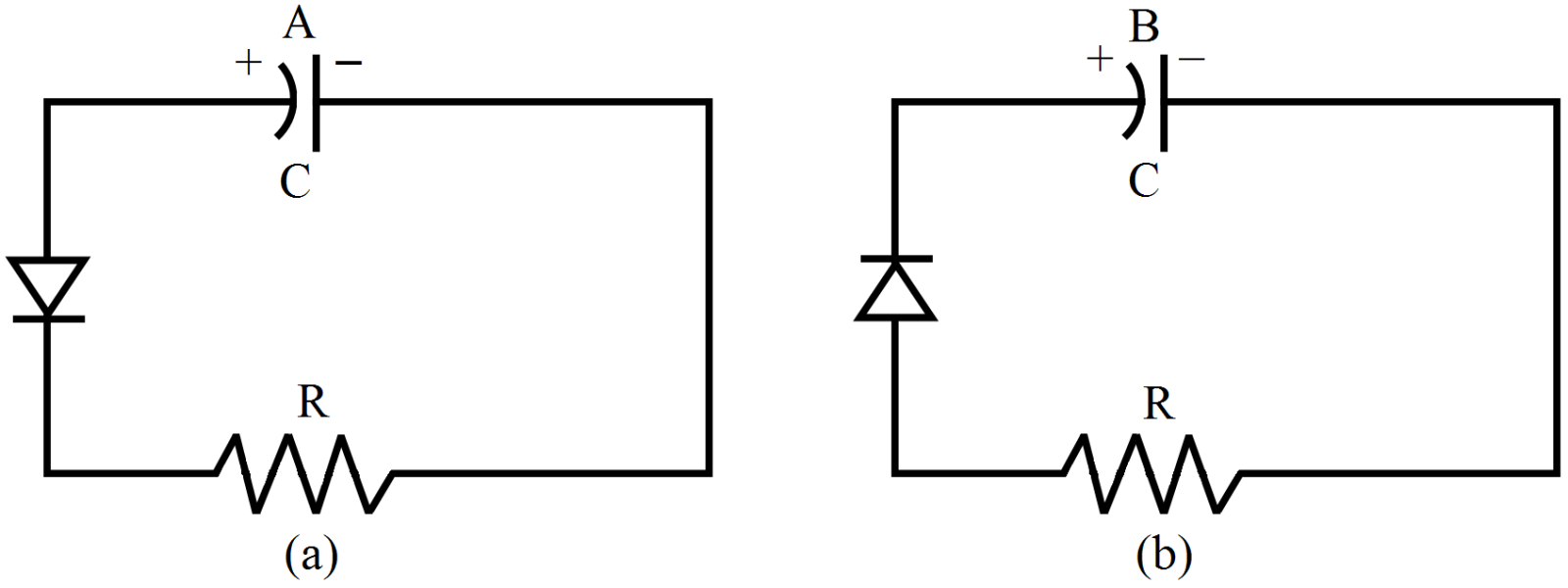
Two identical capacitors $A$ and $B$ are charged to the same potential $V$ and are connected in two circuits at $t = 0$ as shown in figure. The charges on the capahltors at a time $t = CR$ are, respectively:
The dielectric constant k of an insulator cannot be
When a resistance of 2 ohm is connected across the terminals of a cell, the current is 0.5 A. When the resistance is increased to 5 ohm, the current is 0.25 A. The e.m.f. of the cell is
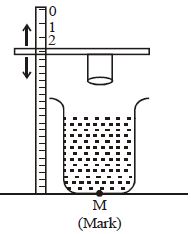
A beaker containing liquid is placed on a table, underneath a microscope which can be moved along a vertical scale. The microscope is focused, through the liquid onto a mark on the table when the reading on the scale is $a$ .

It is next focused on the upper surface of the liquid and the reading is $b$. More liquid is added and the observations are repeated, the corresponding readings are $c$ and $d$. The refractive index of the liquid is

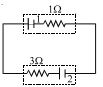
In the figure shown, battery $1$ has $\mathrm{emf}$ $= 6\, V$ and internal resistance $= 1 \,\Omega$. Battery $2$ has $\mathrm{emf}$ $= 2\,V$ and internal resistance $= 3\, \Omega$ . The wires have negligible resistance. What is the potential difference across the terminals of battery $2$ ? ................ $V$
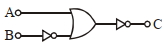
The logic circuit shown above is equivalent to :
A semiconductor having electron and hole motilities $\mu_{ n }$ and $\mu_{ p }$ respectively. if its intrinsic carrier density is $n _{ i }$, then what will be the value of hole concentration $P$ for which the conductivity will be minimum at a given temperature?
The wave theory in its original form was first postulated by:
In the figure below, what is the potential difference between the points $A$ and $B$ and between $B$ and $C$ respectively in steady state
Which gates is represented by this figure