MCQ
Electrode potentials of five elements $A,\,B,\,C,\,D$ and $E$ are respectively $-1.36 , -0.32, 0, -1.26$  and $ -0.42$. The reactivity order of these elements are in the order of
  • $A, D, E, B$ and $ C$
  • B
    $C, B, E, D$ and $A$
  • C
    $B, D, E, A$  and $C$
  • D
    $C, A, E, D $ and $B$

Answer

Correct option: A.
$A, D, E, B$ and $ C$
a
(a)Greater the oxidation potential, greater is the reactivity.

Need a full question paper?

Generate a complete, print-ready paper with questions like this in minutes — across 16+ boards, with answer keys.

Start Generating Free

Similar questions

Which of the graphs shown below does not represent the relationship between incident light and the electron ejected from metal surface?
In the complete combustion of $C_4H_{10}$ the number of oxygen moles required is
Two electrons are revolving around a nucleus at distances $'r'$ and $'4r'$. The ratio of their time periods is
$D- (+)- Glyceraldehyde \xrightarrow[(ii) H_2O/H^+(iii)HNO_3]{(i)HCN}$

The products formed in the above reaction are

Assertion: A mixture of $He$ and $O_2$ is used for respiration for deep sea divers.

Reason: $He$ is soluble in blood.

When $800\,mL$ of $0.5\,M$ nitric acid is heated in a beaker, its volume is reduced to half and $11.5\,g$ of nitric acid is evaporated. The molarity of the remaining nitric acid solution is $x \times 10^{-2}\,M$.(Nearest Integer)(Molar mass of nitric acid is $63\,g\,mol ^{-1}$ )
Match List $I$ with List $II$ 
List $I$ Complex List $II$ Crystal Field splitting energy $\left(\Delta_0\right)$
$A$  $\left[ Ti \left( H _2 O \right)_6\right]^{2+}$ $I$ $-1.2$
$B$ $\left[ V \left( H _2 O \right)_6\right]^{2+}$ $II$ $-0.6$
$C$ $\left[ Mn \left( H _2 O \right)_6\right]^{3+}$ $III$ $0$
$D$ $\left[ Fe \left( H _2 O \right)_6\right]^{3+}$ $IV$ $-0.8$
On moving from left to right across a period in the table the metallic character
Which reagent can convert acetic acid into ethanol
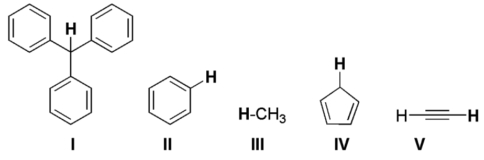
With respect to the compounds $I-V$, choose the correct statement($s$).

$(A)$ The acidity of compound $I$ is due to delocalization in the conjugate base.

$(B)$ The conjugate base of compound IV is aromatic.

$(C)$ Compound II becomes more acidic, when it has a $- NO _2$ substituent.

$(D)$ The acidity of compounds follows the order $I > IV > V > II > III$.