MCQ
Electrolysis involves oxidation and reduction respectively at
- ✓Anode and cathode
- BCathode and anode
- CAt both the electrodes
- DNone of the above
Generate a complete, print-ready paper with questions like this in minutes — across 16+ boards, with answer keys.
The product of the above reaction is

Assertion $(A)$ : Boron is unable to form $BF _{6}^{3-}$
Reason $(R)$ : Size of $B$ is very small.
In the light of the above statements, choose the correct answer from the options given below.
$A \to {\text{Product ;}}\,\, - \frac{{d[A]}}{{dt}} = {k_1}{[A]^o}$
$B \to {\text{Product ;}}\,\, - \frac{{d[B]}}{{dt}} = {k_2}{[B]}$
Units of $k_1$ and $k_2$ are expressed in terms of molarity $(M)$ and time $(sec^{-1})$ as
$(A)$ $E, F$ and $\mathrm{G}$ are resonance structures
$(B)$ $E, F$ and $E, G$ are tautomers
$(C)$ $\mathrm{F}$ and $\mathrm{G}$ are geometrical isomers
$(D)$ $\mathrm{F}$ and $\mathrm{G}$ are diasteromers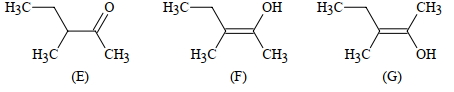
| List-1 | List-II | ||
| (A) | $Al ^{3+}< Mg ^{2+}< Na ^{+}< F ^{-}$ | (I) | Ionisation Enthalpy |
| (B) | B < C < O < N | (II) | Metallic character |
| (C) | B < Al < Mg < K | (III) | Electronegativity |
| (D) | Si < P < S < Cl | (IV) | Ionic radii |