MCQ
Electromagnetic waves travel in a medium which has relative permeability $1.3$ and relative permittivity $2.14.$ Then the speed of the electromagnetic wave in the medium will be
  • A
    $13.6 \times 10^6 \mathrm{~m} / \mathrm{s}$
  • B
    $1.8 \times 10^2 \mathrm{~m} / \mathrm{s}$
  • C
    $3.6 \times 10^8 \mathrm{~m} / \mathrm{s}$
  • $1.8 \times 10^8 \mathrm{~m} / \mathrm{s}$
Answer

Correct option: D.
$1.8 \times 10^8 \mathrm{~m} / \mathrm{s}$

Need a full question paper?

Generate a complete, print-ready paper with questions like this in minutes — across 16+ boards, with answer keys.

Start Generating Free

Similar questions

Force of attraction between the plates of a parallel plate capacitor is
Which one of the following is not electromagnetic in nature(a) X-rays(b) Gamma rays(c) Cathode rays(d) Infrared rays
       
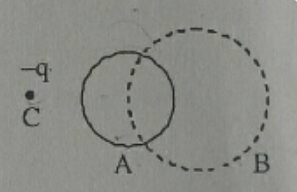
In the figure shown here, A is a conducting sphere and B is a closed spherical surface. If a-q change is placed at C near A, then the electric flux through the closed surface is -
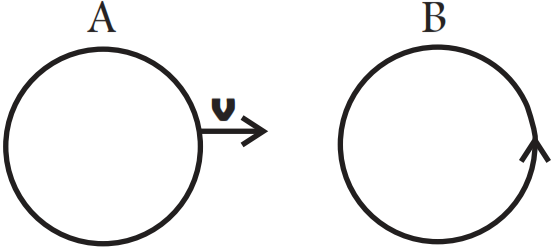
There are two coils A and B as shown in Fig. A current starts flowing in B as shown, when A is moved towards B and stops when A stops moving. The current in A is counterclockwise. B is kept stationary when A moves. We can infer that:
For a metallic wire, the ratio V/i   (V =  the applied potential difference, i = current flowing) is(a) Independent of temperature(b) Increases as the temperature rises(c) Decreases as the temperature rises(d) Increases or decreases as temperature rises, depending upon the metal


If an electron enters a magnetic field with its velocity pointing in the same direction as the magnetic field, then(a) The electron will turn to its right(b) The electron will turn to its left(c) The velocity of the electron will increase(d) The velocity of the electron will remain unchanged


An electron is moving with an initial velocity $\text{v}=\text{v}_0\hat{\text{i}}$ and is in a magnetic field $\text{B}=\text{B}_0\hat{\text{j}}$. Then it's de Broglie wavelength:
A bi-convex lens made of glass (refractive index 1.5) is put in a liquid of refractive index 1.7. Its focal length will(a) Decrease and change sign(b) Increase and change sign(c) Decrease and remain of the same sign(d) Increase and remain of the same sign


How many resistances are used in a Wheatstone bridge?
A body is rotating uniformly about a vertical axis fixed in an inertial frame. The resultant force on a particle of the body not on the axis is:
  1. Vertical.
  2. Horizontal and skew with the axis.
  3. Horizontal and intersecting the axis.
  4. None of these.