MCQ
Electromagnetic waves travel only through.
- Amaterial medium
- Bvacuum
- Coscillating electric and magnetic fields
- Doscillating electric and magnetic fields whose directions are perpendicular to each other
Explanation:
Electromagnetic waves travel through oscillating electric and magnetic fields whose directions are perpendicular to each other.
Generate a complete, print-ready paper with questions like this in minutes — across 16+ boards, with answer keys.
The photoelectric effect can be understood on the basis of
|
(a) The principle of superposition |
(b) The electromagnetic theory of light |
|
(c) The special theory of relativity |
(d) Line spectrum of the atom |
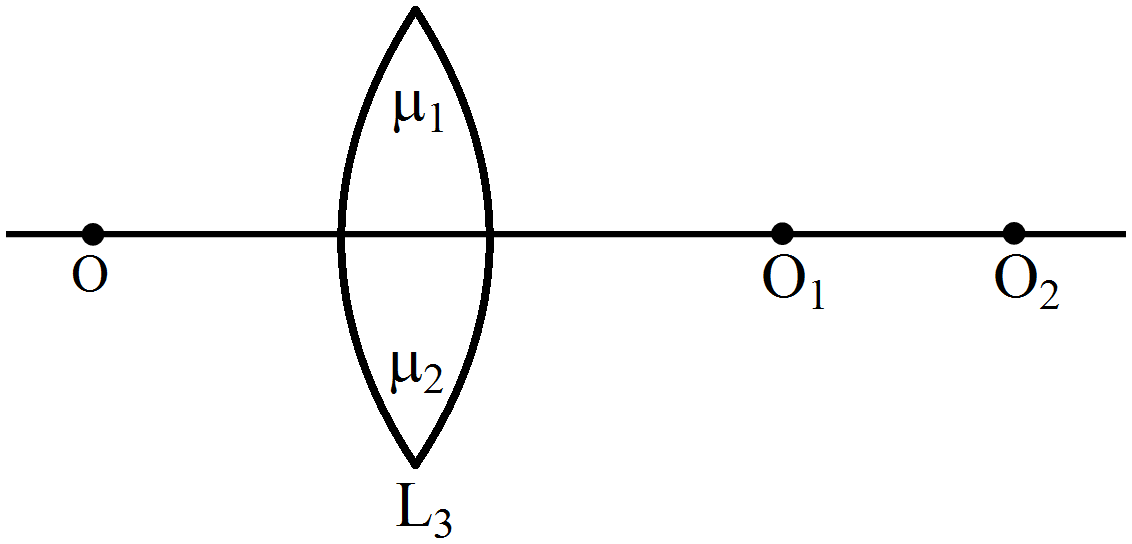
Consider three converging lenses L1, L2 and L3 having identical geometrical construction. The index of refraction of L1 and L2 are $\mu_1$ and $\mu_2$ respectively. The upper half of the lens L3 has a refractive index $\mu_1$ and the lower half has $\mu_2$. A point object O is imaged at O1 by the lens L1 and at O2 by the lens L2 placed in same position. If L3 is placed at the same place:
Energy bands in solids are a consequence of
|
(a) Ohm’s Law |
(b) Pauli’s exclusion principle |
|
(c) Bohr’s theory |
(d) Heisenberg’s uncertainty principle |
Assertion : Silicon is preferred over germanium for making semiconductor devices.
Reason : The energy gap for germanium is more than the energy gap of silicon.
|
(a) If both assertion and reason are true and the reason is the correct explanation of the assertion. |
|
(b) If both assertion and reason are true but reason is not the correct explanation of the assertion. |
|
(c) If assertion is true but reason is false. |
|
(d) If the assertion and reason both are false. |
The lateral displacement depends on ______: