MCQ
Electromagnetic waves travel only through.
  • A
    material medium
  • B
    vacuum
  • C
    oscillating electric and magnetic fields
  • oscillating electric and magnetic fields whose directions are perpendicular to each other

Answer

Correct option: D.
oscillating electric and magnetic fields whose directions are perpendicular to each other

Electromagnetic waves travel through oscillating electric and magnetic fields whose directions are perpendicular to each other.

Need a full question paper?

Generate a complete, print-ready paper with questions like this in minutes — across 16+ boards, with answer keys.
Start Generating Free

Similar questions

In ${88^{Ra}}^{226}$ nucleus, there are
When the length of the tube of a microscope is increased, the magnifying power will be :
Which of the following statements are true regarding radioactivity
(I) All radioactive elements decay exponentially with time
(II) Half life time of a radioactive element is time required for one half of the radioactive atoms to disintegrate
(III) Age of earth can be determined with the help of radioactive dating
(IV) Half life time of a radioactive element is 50% of its average life period
Select correct answer using the codes given below
Codes :
E denotes electric field in a uniform conductor, I corresponding current through it, $V_d$ drift velocity of electrons and P denotes thermal power produced in the conductor, then which of the following graph is incorrect
Which of the following will have highest penetrating power
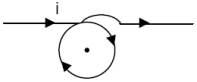
In the figure, find out the magnetic field at $B$ (Given $I =2.5 \;A,r =5\, cm )$
Two free positive charges $4q$ and $q$ are a distance $l$ apart. What charge $Q$ is needed to achieve equilibrium for the entire system and where should it be placed form charge $q$ ?
An electric dipole of moment $\vec P$ is placed in a uniform electric field $\vec E$ such that $\vec P$ points along $\vec E$ . If the dipole is slightly rotated about an axis perpendicular to the plane containing $\vec E$ and $\vec P$ and passing through the centre of the dipole, the dipole executes simple harmonic motion. Consider $I$ to be the moment of inertia of the dipole about the axis of rotation. What is the time period of such oscillation?
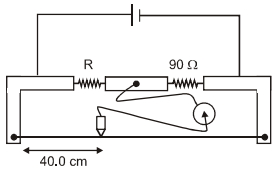
During an experiment with a metre bridge, the galvanometer shows a null point when the joceky is pressed at $40.0 \ cm$ using a standard resistance of $90 \ \Omega$, as shown in the figure. The least count of the scale used in the meter bridge is $1 \ mm$. The unknown resistance is:
An ion beam of specific charge $5 \times 10^7$ $coulomb/kg$ enter a uniform magnetic field of $4 \times 10^{-2}\, tesla$ with a velocity $2 \times 10^5\, m/s$ perpendicularly. The radius of the circular path of ions in meter will be