MCQ
Electron affinity depends on
  • A
    Atomic size
  • B
    Nuclear charge
  • C
    Atomic number
  • Atomic size and nuclear charge both

Answer

Correct option: D.
Atomic size and nuclear charge both
d
Electron affinity is the amount of energy released when an electron is added to a neutral atom to form a negative ion. $EA$ decreases on moving down the group as the atomic size increases and net nuclear charge increase is offset by extra screening electrons as the additional electron enters an orbital away from the nucleus. So, it is less attracted to nucleus and would release less energy when added.

Need a full question paper?

Generate a complete, print-ready paper with questions like this in minutes — across 16+ boards, with answer keys.

Start Generating Free

Similar questions

Assuming that Hund's rule is violated, the bond order and magnetic nature of the diatomic molecule $B_2$ is
Which of the following will show maximum osmotic pressure for its  $1\,\,m$  solution ?
When a liquid boils, there is
Glycerol reacts with conc. $HN{O_3}$ and conc. ${H_2}S{O_4}$ to form
Which of the statements about "Denaturation" given below are correct ?

$(1)$ Denaturation of proteins causes loss of secondary and tertiary structures of the protein.

$(2)$ Denaturation leads to the conversion of double strand of $DNA$ into single strand.

$(3)$ Denaturation affects primary structure which gets distorted.
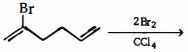
How many stereoisomeric pentabrornides will be formed in the following reaction ?
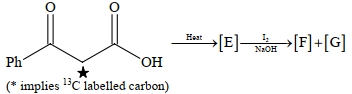
In the following reaction sequence, the correct structures of $\mathrm{E}, \mathrm{F}$ and $\mathrm{G}$ are
For a concentrated solution of a weak electrolyte ( $K _{ eq }=$ equilibrium constant) $A _2 B _3$ of concentration ' $c$ ', the degree of dissociation " $\alpha$ ' is
The number of Faraday required to generate $1$ $g$ $atom$ of $Mg$ from $MgCl_2$ is :-
Which of these reagents would accomplish the following reduction ?

$\begin{matrix}
   O\,\,\,\,\,\,\,\,\,\,\,\,\,\,\,\, \,\, \\
   ||\,\,\,\,\,\,\,\,\,\,\,\,\,\,\,\,\,\,  \\
   N\equiv C-C{{H}_{2}}-C-C{{H}_{2}}-CH=C{{H}_{2}}\to   \\
\end{matrix}$ $\begin{matrix}
   OH\,\,\,\,\,\,\,\,\,  \\
   |\,\,\,\,\,\,\,\,\, \,\,\,\, \\
   N\equiv C-C{{H}_{2}}-\underset{H}{\mathop{C}}\,-C{{H}_{2}}-CH=C{{H}_{2}}  \\
\end{matrix}$