MCQ
Electron beam used in an electron microscope, when accelerated by a voltage of $20\,kV$. has a de-Broglie wavelength of $\lambda_0$. If the voltage is increased to $40\,kV$. then the de-Broglie wavelength associated with the electron beam would be:
  • A
    $3 \lambda_0$
  • B
    $9 \lambda_0$
  • C
    $\frac{\lambda_0}{2}$
  • $\frac{\lambda_0}{\sqrt{2}}$

Answer

Correct option: D.
$\frac{\lambda_0}{\sqrt{2}}$
d
When electron is accelerated through potential difference $V$, then

$\text { K.E. }= eV$

$\Rightarrow \lambda=\frac{ h }{\sqrt{2 m ( KE )}}=\frac{ h }{\sqrt{2 meV }}$

$\therefore \quad \lambda \propto \frac{1}{\sqrt{ V }}$

$\therefore \quad \frac{\lambda}{\lambda_0}=\sqrt{\frac{20}{40}}$

$\therefore \quad \lambda=\frac{\lambda_0}{\sqrt{2}}$

Need a full question paper?

Generate a complete, print-ready paper with questions like this in minutes — across 16+ boards, with answer keys.

Start Generating Free

Similar questions

A wave represented by the given equation $Y = A\sin \left( {10\,\pi \,x + 15\,\pi \,t + \frac{\pi }{3}} \right)$, where $x$ is in meter and $t$ is in second. The expression represents
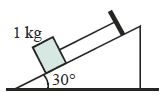
The coefficient of friction between two surfaces is $\mu  = 0.8$.The tension in the string shown in the figure is ........ $N$ 
Assuming human pupil to have a radius of $0.25\ cm$ and a comfortable viewing distance of $25\ cm$, the minimum separation between two objects that human eye can resolve at $500\ nm$ wavelength is.....$\mu m$
A solid sphere is rolling without slipping on a horizontal plane. The ratio of the linear kinetic energy of the centre of mass of the sphere and rotational kinetic energy is :
A double charged lithium atom is equivalent to hydrogen whose atomic number is $3$. The wavelength of required radiation for emitting electron from first to third Bohr orbit in $L{i^{ + + }}$ will be.......$\mathop A\limits^o $ (Ionisation energy of hydrogen atom is $13.6\,eV$)
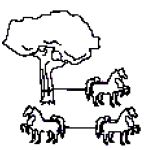
In order to test the strength of a rope, one end is tied to a large tree and the other end is  hitched to a team of $2$ horses. The horse pull as hard as they can, but cannot break the  rope. If the rope is untied from the tree and attached to another team of $2$ horses  with equal strength, and the two teams pull in opposite directions, the tension in the rope  will
Select the appropriate property of an ideal gas
A charged particle going around in a circle can be considered to be a current loop. A particle of mass $m$ carrying charge $q$ is moving in a plane with speed $v$ under the influence of magnetic field $\overrightarrow{ B }$. The magnetic moment of this moving particle
The figure shows a bar magnet and a metallic coil. Consider four situations:

$(I)$ Moving the magnet away from the coil.

$(II)$ Moving the coil towards the magnet.

$(III)$ Rotating the coil about the vertical diameter.

$(IV)$ Rotating the coil about its axis.

An emf in the coil will be generated for the following situations.

New SI unit of mass $1 \,kg$ is defined in terms of the difference in the masses of two ${ }^{133} Cs _{55}$ atoms. One of these atoms is in its ground state and the other in an excited state that has frequency of excitation close to $9.2 \times 10^9 \,Hz$. Number of atoms required to get $1 \,kg$ of mass this way is the order of (Planck's constant = $6.63 \times 10^{-34} \,J s ;$ mass of proton $=1.67 \times 10^{-27}$ $kg$; Avogadro number $=6.02 \times 10^{23}$ particles; speed of light $=3 \times 10^8 \,m / s$ )