Question
Electron volt is the unit of which physical quantity?

Answer

Energy. 

Need a full question paper?

Generate a complete, print-ready paper with questions like this in minutes — across 16+ boards, with answer keys.

Start Generating Free

Similar questions

What is the relationship between the total energy and oscillation frequency of a simple pendulum?
In what type of collision, maximum kinetic energy is transferred?
A cylinder of mass 10kg and radius 15cm is rolling perfectly on a plane of inclination 30°. The coefficient of static friction $\mu_\text{s}= 0.25$
  1. How much is the force of friction acting on the cylinder?
  2. What is the work done against friction during rolling?
  3. If the inclination $\theta$ of the plane is increased, at what value of $\theta$ does the cylinder begin to skid, and not roll perfectly?
A simple harmonic motion is described by a = -16x where a → acceleration and x is displacement in meter. What is the time period?
  1. On the basis of Charle's law, what is the minimum possible temperature?
  2. What is the volume of gas at absolute zero temperature?
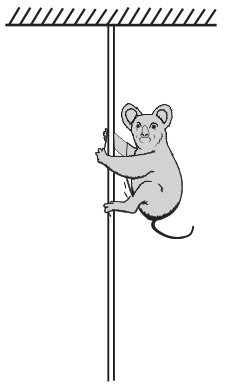
A monkey of mass 40kg climbs on a rope (Fig.) which can stand a maximum tension of 600 N. In which of the following cases will the rope break: the monkey,

  1. Climbs up with an acceleration of 6ms-2.
  2. Climbs down with an acceleration of 4ms-2.
  3. Climbs up with a uniform speed of 5ms-1.
  4. Falls down the rope nearly freely under gravity?

(Ignore the mass of the rope).

What is the frequency of oscillation of a simple pendulum mounted in a cabin that is freely falling under gravity?
The sign of work done by a force on a body is important to understand. State carefully if the following quantities are positive or negative:
Work done by an applied force on a body moving on a rough horizontal plane with uniform velocity.
If the velocity of the center of mass of the particle system is zero, then will the velocities of its various particles necessarily be zero?
Two particles A and B start from rest and move for equal time on a straight line. The particle A has an acceleration a for the first half of the total time and 2a for the second half. The particle B has an acceleration 2a for the first half and a for the second half. Which particle has covered larger distance?