MCQ
Electrons accelerated from rest by an electrostatic potential are collimated and sent through a Young's double slit experiment. The fringe width is $\omega$. If the accelerating potential is doubled, then the width is now close to ............. $\omega$
  • A
    $0.5$
  • $0.7$
  • C
    $1.0$
  • D
    $2.0$

Answer

Correct option: B.
$0.7$
b
$(b)$ When electrons are accelerated through a potential of $V$ volts, momentum gained by electrons is

$\Delta p =m v=\sqrt{2 m K}$

$=\sqrt{2 m e V}$

where, $K=$ kinetic energy, $m=$ mass of electron, $v=$ velocity of electron and $e=$ charge of electron.

Wavelength $\lambda$ associated with these moving electrons is

$\lambda=\frac{h}{p}=\frac{h}{\sqrt{2 m e V}}$

where, $h$ is the Planck's constant.

Fringe width $\beta$ shown by electrons in Young's double slit experiment, is

$\beta=\frac{\lambda D}{ d }$

where, $D$ is the distance of screen from fringes and $d$ is the separation of slits. $\therefore \quad \beta=\frac{h D}{d \sqrt{2 m e V}}$ $\Rightarrow \beta \propto \frac{1}{\sqrt{V}}$, keeping other parameters constant.

So, ratio of initial and final fringe widths is

$\Rightarrow \frac{\beta_{i}}{\beta_{f}}=\frac{\sqrt{V_{f}}}{\sqrt{V_{i}}}=\frac{\sqrt{2 V_{i}}}{\sqrt{V_{i}}}$

$\Rightarrow \beta_{f}=\frac{\beta_{i}}{\sqrt{2}}=0.7 \beta_{i}$

$\Rightarrow \left.\beta_{f}=0.7(\omega) \quad \text { (given, } \beta_{i}=\omega\right)$
Need a full question paper?

Generate a complete, print-ready paper with questions like this in minutes — across 16+ boards, with answer keys.

Start Generating Free

Similar questions

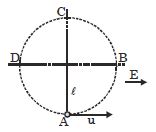
A simple pendulum with a bob of mass $m = 1\ kg$ , charge $q = 5\mu C$ and string length $l = 1\ m$ is given a horizontal velocity $u$ in a uniform electric field $E = 2 × 10^6\ V/m$ at its bottom most point $A$ , as shown in figure. It is given a speed $u$ such that the particle leave the circular path at its topmost point $C$ . Find the speed $u$ . (Take $g = 10\ m/s^2$ )
What is the net electric field in the outer regions above the upper plate and below the lower plate in a parallel plate capacitor?
The energy equivalent of $0.5\, g$ of a substance is$........J$
The specific resistance of all metals is most affected by
A small pin fixed on a table top is viewed from above from a distance of $50\, cm$. By what distance would the pin appear to be raised if it is viewed from the same point through a $15\, cm$ thick glass slab held parallel to the table? Refractive index of glass $= 1.5$ ?......$cm$
A charge of $1$ coulomb is located at the centre of a sphere of radius $10 \,cm$ and a cube of side $20 \,cm$. The ratio of outgoing flux from the sphere and cube will be
An electric bulb illuminates a plane surface. The intensity of illumination on the surface at a point $2$ m away from the bulb is $5 \times 10^{-4}$ phot (lumen/ $cm ^2$ ). The line joining the bulb to the point makes an angle of $60^{\circ}$ with the normal to the surface. The intensity of the bulb in candela is
A student performed the experiment of determination of focal length of a concave mirror by $u-v$ method using an optical bench of length $1.5$ meter. The focal length of the mirror used is $24 \mathrm{~cm}$. The maximum error in the location of the image can be $0.2 \mathrm{~cm}$. The $5$ sets of ( $\mathrm{u}, \mathrm{v})$ values recorded by the student (in $\mathrm{cm}$ ) are: $(42,56$ ), $(48,48),(60,40),(66,33),(78,39)$. The data set$(s)$ that cannot come from experiment and is $(are)$ incorrectly recorded, is $(are)$

$(A)$ $(42,56)$ $(B)$ $(48,48)$ $(C)$ $(66,33)$ $(D)$ $(78,39)$

Electric potential at any point is $V = - 5x + 3y + \sqrt {15} z$, then the magnitude of the electric field is
A coil of inductance $L$ has an inductive reactance of ${X_L}$ in an AC circuit in which the effective current is I. The coil is made from a super-conducting material and has no resistance. The rate at which power is dissipated in the coil is