Question
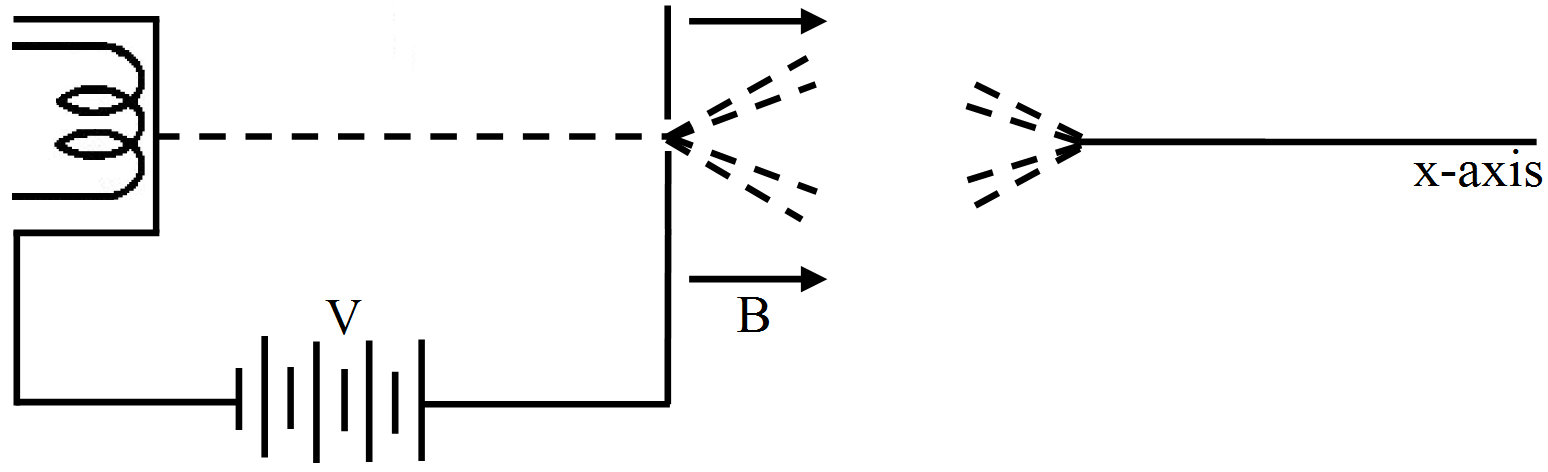
Electrons emitted with negligible speed from an electron gun are accelerated through a potential difference V along the x-axis. These electrons emerge from a narrow hole into a uniform magnetic field B directed along this axis. However, some of the electrons emerging from the hole make slightly divergent angles, as shown in the figure. Show that these paraxial electrons are refocussed on the x-axis at a distance $\sqrt{\frac{8\pi^2\text{mV}}{\text{eB}^2}}.$
Answer

Given magnetic field = B, Pd = V, mass of electron = m, Charge = q, Let electric field be ‘E’
$\therefore\text{E}=\frac{\text{V}}{\text{R}'}$
Force Experienced = eE Acceleration $=\frac{\text{eE}}{\text{m}}=\frac{\text{eE}}{\text{Rm}}$ Now, $V^2 = 2 \times a \times s$
$[\because\text{x}=0]$
$\text{V}=\sqrt{\frac{2\text{e}\times\text{V}\times\text{R}}{\text{Rm}}}=\sqrt{\frac{\text{2eV}}{\text{m}}}$
Time taken by particle to cover the arc $=\frac{2\pi\text{m}}{\text{qB}}=\frac{2\pi\text{m}}{\text{eB}}$ Since the acceleration is along ‘Y’ axis. Hence it travels along x axis in uniform velocity, Therefore, $\text{v}\times\text{t}=\sqrt{\frac{2\text{em}}{\text{m}}}\times\frac{2\pi\text{m}}{\text{eB}}\sqrt{\frac{8\pi^2\text{mV}}{\text{eB}^2}}$

Need a full question paper?

Generate a complete, print-ready paper with questions like this in minutes — across 16+ boards, with answer keys.

Start Generating Free

Similar questions

A body describes simple harmonic motion with an amplitude of 5cm and a period of 0.2s. Find the acceleration and velocity of the body when the displacement is (a) 5cm (b) 3cm (c) 0cm.
A thin rod having length $L_0$ at $0°C$ and coefficient of linear expansion $\alpha$ has its two ends maintained at temperatures $\theta_1$ and $\theta_2,$ respectively. Find its new length.
A current of $1.0A$ exists in a copper wire of cross-section $1.0mm^2$. Assuming one free electron per atom, calculate the drift speed of the free electrons in the wire. The density of copper is $9000kg/m^{-3}$.
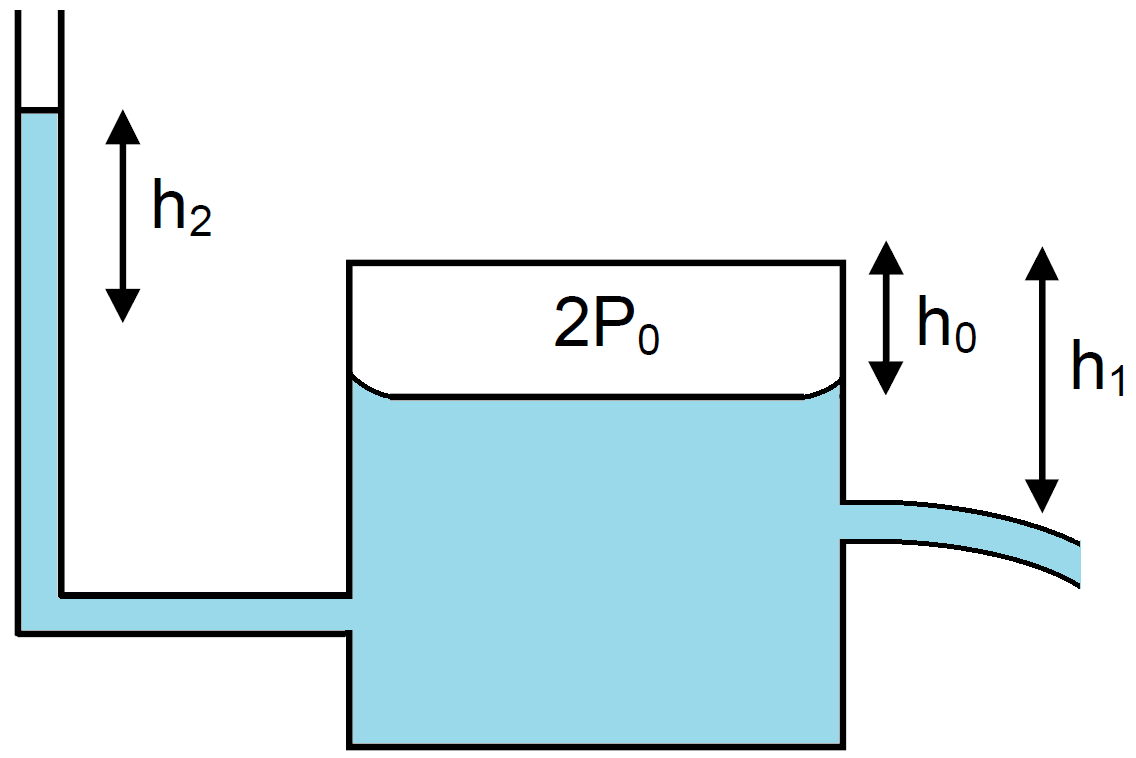
Figure. shows a large closed cylindrical tank containing water. Initially the air trapped above the water surface has a height $h_0$ and pressure $2p_0$ where $p_0$ is the atmospheric pressure. There is a hole in the wall of the tank at a depth $h_1$ below the top from which water comes out. A long vertical tube is connected as shown.
  1. Find the height $h_2$ of the water in the long tube above the top initially.
  2. Find the speed with which water comes out of the hole.
  3. Find the height of the water in the long tube above the top when the water stops coming out of the hole.
A uniform field of $2.0NC^{-1}$ exists in space in x-direction.
  1. Taking the potential at the origin to be zero, write an expression for the potential at a general point (x, y, z).
  2. At which points, the potential is $25V$?
  3. If the potential at the origin is taken to be $100V$, what will be the expression for the potential at a general point?
  4. What will be the potential at the origin if the potential at infinity is taken to be zero? Is it practical to choose the potential at infinity to be zero?
Consider the situation of the previous problem. A charges of $-2.0 \times 10^{-4}C$ is moved from the point A to the point B. Find the change in electrical potential energy $U_B - U_A$ for the cases (a), (b) and (c).
For the motion of a body due to external force, prove that its entire mass can be considered concentrated at the center of mass.
Explain why friction is necessary to make the disc in roll in the direction indicated.
  1. Give the direction of frictional force at B, and the sense of frictional torque, before perfect rolling begins.
  2. What is the force of friction after perfect rolling begins?
A body of mass 5kg is acted upon by two perpendicular forces 8N and 6N. Give the magnitude and direction of the acceleration of the body.
What is thermal expansion of gases? Prove that the value of volume coefficient and pressure coefficient are equal.