Question
Electroscope is used:

Answer

  1. To detect and test small electric charges.
Explanation:
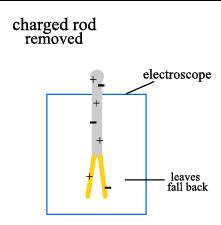
Electroscope is an old electrical instrument, used to detect the presence and magnitude of electric charges on a body.

Need a full question paper?

Generate a complete, print-ready paper with questions like this in minutes — across 16+ boards, with answer keys.
Start Generating Free

Similar questions

For television broadcasting, the frequency employed is normally(a) 30-300 MHz(b) 30-300 GHz(c) 30-300 KHz(d) 30-300 Hz
       
In a series $\text{LCR}$ circuit, resonance occurring at $105\ Hz.$ At that time, the potential difference across the $100$ resistance is $40V$ while the potential difference across the pure inductor is $30v.$ The inductance $L$ of the inductor is equal to.
The work function of a metallic surface is $5.01\ eV.$ The photo-electrons are emitted when light of wavelength $2000\ \mathring A $ falls on it. The potential difference applied to stop the fastest photo-electrons is  $\left[ h =4.14 \times 10^{-15} eV \sec \right]$
In an electric circuit containing a battery, the charge (assumed positive) inside the battery:
  1. Always goes from the positive terminal to the negative terminal.
  2. May go from the positive terminal to the negative terminal.
  3. Always goes from the negative terminal to the positive terminal
  4. Does not move.
Assertion  :   Silicon is preferred over germanium for making semiconductor devices.
Reason      : The energy gap for germanium is more than the energy gap of silicon.(a) If both assertion and reason are true and the reason is the correct explanation of the assertion.(b) If both assertion and reason are true but reason is not the correct explanation of the assertion.(c) If assertion is true but reason is false.(d) If the assertion and reason both are false.


A plane electromagnetic wave is incident on a material surface. The wave delivers momentum p and energy E.
A moving coil galvanometer has N number of turns in a coil of effective area A, it carries a current I. The magnetic field B is radial. The torque acting on the coil is:
A bar magnet when placed at an angle of $30^\circ$ to the direction of magnetic field induction of $5 \times 10^{–2} T,$ experiences a moment of couple $25 \times 10^{–6} N-m$. If the length of the magnet is $5 \ cm$ its pole strength is
Light rays from a source are incident on a glass prism of index of refraction μ and angle of prism α. At near normal incidence, the angle of deviation of the emerging rays is(a) (μ – 2)α (b) (μ – 1) α (c) (μ + 1) α (d) (μ + 2) α
       
The electronic transition from $n = 2$ to $n = 1$ will produce shortest wavelength in: