MCQ
Electrovalent bond formation depends on
  • A
    IonizatioElectron affinityenergy
  • B
    Electron affinity
  • C
    Lattice energy
  • All the three above

Answer

Correct option: D.
All the three above
d
Electrovalent bond formation depends on ionization energy of cation, electron affinity of anion and on lattice energy

Need a full question paper?

Generate a complete, print-ready paper with questions like this in minutes — across 16+ boards, with answer keys.

Start Generating Free

Similar questions

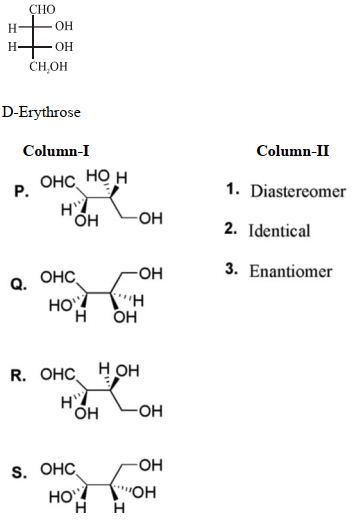
The Fischer projection of $D$-erythrose is shown below.

(image)

$D$-Erythrose and its isomers are listed as $P , Q , R$, and $S$ in Column-$I$. Choose the correct relationship of $P , Q , R$, and $S$ with D-erythrose from Column $II$.

(image)
The energy of one mole of photons of radiation of wavelength $300 nm$ is ...... $kJ \,mol ^{-1}$. 

(Given : $h =6.63 \times 10^{-34} \,Js , N _{ A }=6.02 \times 10^{23} \,mol ^{-1}$, $c =3 \times 10^{8}\, ms ^{-1}$ )
The average molar mass of chlorine is $35.5\, g$ $mol ^{-1}$. The ratio of $35\, Cl$ to $37 \,Cl$ in naturally occurring chlorine is close to :
An aqueous solution of sodium carbonate is alkaline because sodium carbonate is a salt of
From the following $0.1\, M$ solution of compound, will be basic in nature
One gram sample of $N{H_4}N{O_3}$ is decomposed in a bomb calorimeter. The temperature of the calorimeter increases by $ 6.12\, K$  the heat capacity of the system is  $1.23\, kJ/g/deg.$  What is the molar heat of decomposition for $N{H_4}N{O_3}$ ......$kJ/mol$
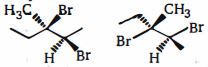
How are the following compounds related ?
One mole of ${N_2}{H_4}$ loses $10\, mol$ of electrons to form a new compound $Y$. Assuming that all nitrogen appear in the new compound, what is the oxidation state of ${N_2}$ in $Y$ ? (There is no change in the oxidation state of hydrogen)
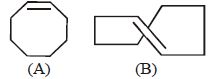
Relation between $(A)$ and $(B)$ is
The ionic radii of $\mathrm{F}^{-}$ and $O^{2-}$ respectively are $1.33\, A^o$ and $1.4\, A^o$, while the covalent radius of $\mathrm{N}$ is $0.74\,A^o$ 

The correct statement for the ionic radius of $\mathrm{N}^{3-}$ from the following is :