Question
Elemental semiconductor and compound semiconductors. Explain with examples.

Answer

Following are the examples of elemental semiconductor and compound semiconductor :
(i) Elemental semiconductors : Si and Ge
(ii) Compound semiconductors :
• Inorganic : CdS, GaAs, CdSe, InP etc.
• Organic anthracenes, doped phthalocyanates etc.
• Organic polymers : polypyrrole, polyaniline, polythiophene etc.

Need a full question paper?

Generate a complete, print-ready paper with questions like this in minutes — across 16+ boards, with answer keys.
Start Generating Free

Similar questions

The electric current existing in a discharge tube is $2.0\mu\text{A}.$ How much charge is transferred across a cross-section of the tube in 5 minutes?
Answer the following questions: Magnifying power of a simple microscope is inversely proportional to the focal length of the lens. What then stops us from using a convex lens of smaller and smaller focal length and achieving greater and greater magnifying power?
A uranium$-238$ nucleus, initially at rest, emits an alpha particle with a speed of $1.4 \times 10^7m/s.$ Calculate the recoil speed of the residual nucleus thorium$-234.$ Assume that the mass of a nucleus is proportional to the mass number.
Any current flowing through a copper wire when passed through an iron wire of same thickness. What will be the effect on its drift velocity?
Sketch the magnetic field lines for a current-carrying circular loop near its centre. Replace the loop by an equivalent magnetic dipole and sketch the magnetic field lines near the centre of the dipole. Identify the difference.
On increasing the current drawn from a cell, the net potential difference across its terminals is lowered, why?
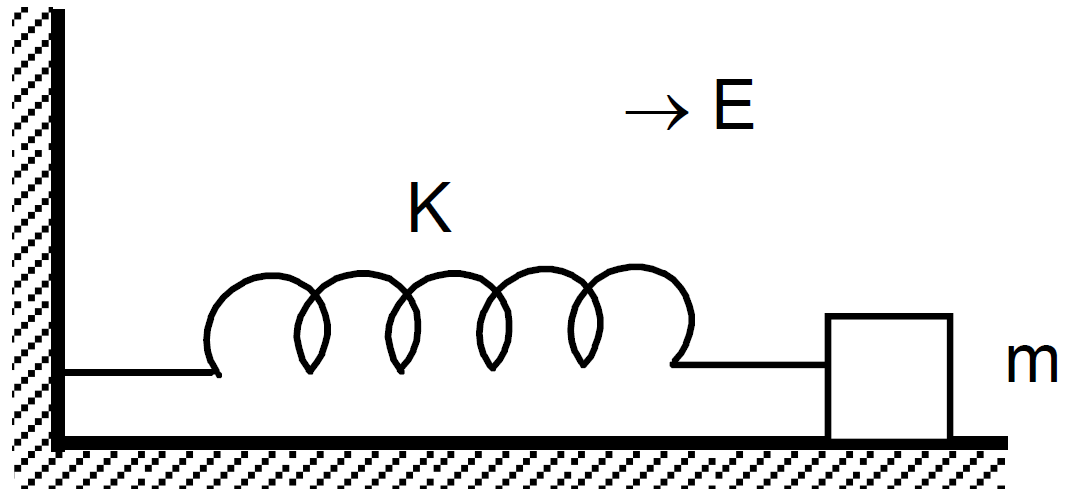
A block of mass m having a charge q is placed on a smooth horizontal table and is connected to a wall through an unstressed spring of spring constant k as shown in figure. A horizontal electric field E parallel to the spring is switched on. Find the amplitude of the resulting SHM of the block.
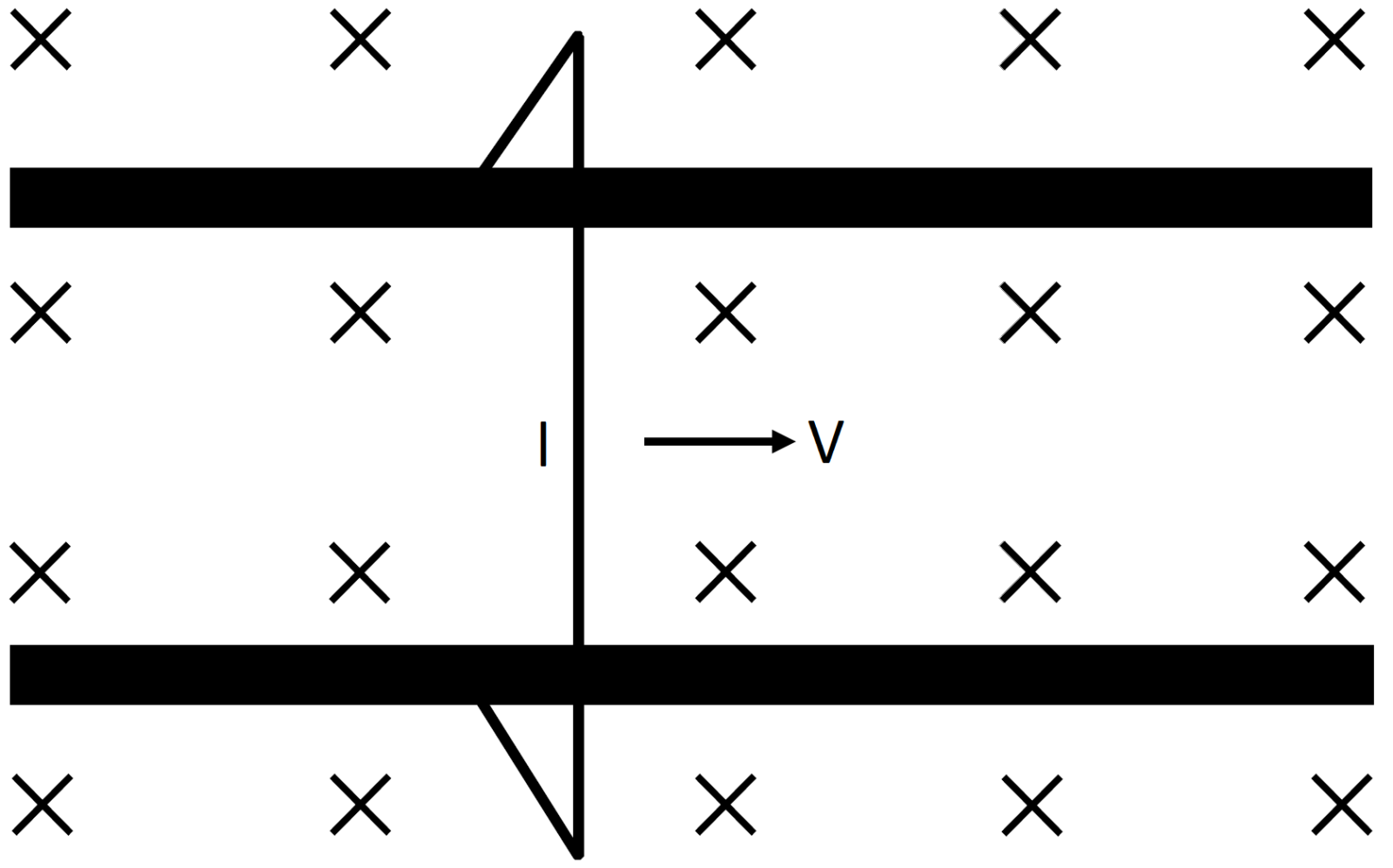
Figure shows a wire sliding on two parallel, conducting rails placed at a separation l. $A$ magnetic field $B$ exists in a direction perpendicular to the plane of the rails. What force is necessary to keep the wire moving at a constant velocity $v?$​​​​​​​
A car moving at $40\ km/h$ is to be stopped by applying brakes in the next $4.0m$. If the car weighs $2000\ kg$, what average force must be applied on it?
Define the term ‘Half$-$life’ of a radioactive substance. Two different radioactive substances have half$-$lives $T_1$ and $T_2$ and number of undecayed atoms at an instant $N_1$ and $N_2,$ respectively. Find the ratio of their activities at that instant.