MCQ
Elements of which group form anions most readily
- AOxygen family
- BNitrogen group
- ✓Halogens
- DAlkali metals
Generate a complete, print-ready paper with questions like this in minutes — across 16+ boards, with answer keys.
|
${List-I }$ ${(Reactants) }$ |
${List-II }$ ${ Products }$ |
| ($A$)Phenol, $\mathrm{Zn} / \Delta$ |
$(I)$ Salicylaldehyde |
| ($B$)Phenol, $\mathrm{CHCl}_3, \mathrm{NaOH}, \mathrm{HCl}$ |
$(II)$ Salicylic acid |
| ($C$)Phenol, $\mathrm{CO}_2, \mathrm{NaOH}, \mathrm{HCl}$ |
$(III)$ Benzene |
| ($D$)Phenol, Conc. $\mathrm{HNO}_3$ |
$(IV)$ Picric acid |
$CH _{2} = C = C H - C H _{3}$
$\quad 1\quad \quad 2\quad \quad 3\quad \quad \quad 4$
molecule, the hybridization of carbon $1,2,3$ and $4$ respectively are :
$20 \;g \;\;\;\;5 \;g$
Consider the above reaction, the limiting reagent of the reaction and number of moles of $NH _{3}$ formed respectively are
$\begin{array}{*{20}{c}}
{{H_3}COOC - CH - COOC{H_3}} \\
{|\,\,} \\
{\,\,\,\,\,\,C{H_2}OH}
\end{array}$
Choose the correct answer from the options given below.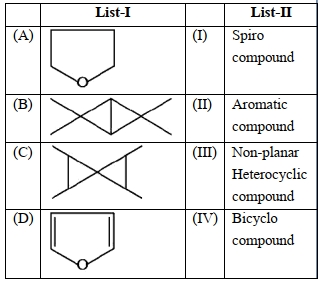
$(a)$ Photon is a positively charged nuclear particle
$(b)$ Size of nucleus is very small as compared to the size of atom
$(c)$ Photoelectric effect and diffraction show particle nature of light
$(d)$ Planck's constant has same dimensions as angular momentum
The correct statements is/are