MCQ
Elements which generally exhibit multiple oxidation states and whose ions are usually coloured are
  • A
    Metalloids
  • Transition elements
  • C
    Non-metals
  • D
    Gases

Answer

Correct option: B.
Transition elements
b
(b)They show multiple oxidation state due to availability of vacant $d-$ orbitals.
They are coloured due to $d-d $ transition.

Need a full question paper?

Generate a complete, print-ready paper with questions like this in minutes — across 16+ boards, with answer keys.

Start Generating Free

Similar questions

The correct order of $S - S$ bond length in following oxyanions is :

$(I) \,S _{2} O _{4}^{2-}$

$(I I)\, S _{2} O _{5}^{2-}$

$(III) \,S _{2} O _{6}^{2-}$

The orbital angular momentum of an electron in $2s$ orbitals is
The number of $2p$ electrons having spin quantum number $s = - 1/2$ are
The energy of an electron in the first Bohr orbit of $H$atom is $ - 13.6\,eV$. The possible energy value $(s)$ of the excited state $(s)$ for electrons in Bohr orbits to hydrogen is(are) ............. $\mathrm{eV}$
Identify major product of the reaction, when the given compound is hydrolysed  and heated strongly
The order of reactivity of following alcohols with halogen acids is ______

$(A)$   $CH_3CH_2-CH_2-OH$        $ (B) $  $\begin{array}{*{20}{c}}
  {C{H_3} - C{H_2} - CH - OH} \\ 
  {\,\,\,\,\,\,\,\,\,\,\,\,\,\,\,\,\,|} \\ 
  {\,\,\,\,\,\,\,\,\,\,\,\,\,\,\,\,\,\,\,\,\,\,\,C{H_3}} 
\end{array}$   

$(C)$   $\begin{array}{*{20}{c}}
  {\,\,\,\,\,\,\,\,\,\,\,\,\,\,\,\,\,\,\,\,\,\,\,\,\,\,\,\,C{H_3}} \\ 
  {\,\,\,\,\,\,\,\,\,\,\,\,\,\,\,\,\,\,\,\,\,|} \\ 
  {C{H_3} - C{H_2} - C - OH} \\ 
  {\,\,\,\,\,\,\,\,\,\,\,\,\,\,\,\,\,\,\,\,\,|} \\ 
  {\,\,\,\,\,\,\,\,\,\,\,\,\,\,\,\,\,\,\,\,\,\,\,\,\,\,\,\,C{H_3}} 
\end{array}$
Correct statement is
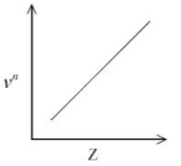
It is observed that characteristic X-ray spectra of elements show regularity. When frequency to the power ' $n$ ' i.e. $v^{ n }$ of X-rays emitted is plotted against atomic number ' $Z$ ', following graph is obtained. The value of ' $n$ ' is
Any $p-$ orbital can accommodate up to:
The temperature dependence of rate constant $(k)$ of a chemical reaction is written in terms of Arrhenius equation, $K = A.{e^{ - E^*/RT}}$. Activation energy $({E^*})$ of the reaction can be calculated by plotting