MCQ
Emf of a cell is:
  • A
    The maximum potential difference between the terminals of a cell when no current is drawn from the cell.
  • B
    The force required to push the electrons in the circuit.
  • C
    The potential difference between the positive and negative terminal of a cell in a closed circuit.
  • D
    Less than terminal potential difference of the cell.
Answer

  1. The maximum potential difference between the terminals of a cell when no current is drawn from the cell.

Need a full question paper?

Generate a complete, print-ready paper with questions like this in minutes — across 16+ boards, with answer keys.

Start Generating Free

Similar questions

The drift current in a p-ri junction is:
  1. From the n-side to the p-side.
  2. From the p-side to the n-side.
  3. From the n-side to the p-side if the junction is forward-biased and in the opposite direction if it is reverse-biased.
  4. From the p-side to the n-side if the junction is forward-biased and in the opposite direction if it is reverse-biased.
Like charges ____ each other.
Electromotive Force (EMF) may be defined as:
$1000\Omega$ resistance and a capacitor of $100\Omega$ resistance are connected in series a 220V source. when the capacitor is 50% charged, the value of the displacement current is.
An inductive coil has resistance of $100\Omega$ When an ac signal of frequency 1000 Hz is fed to the coil, the applied voltage leads the current by 45. What is the inductance of the coil?

For photoelectric emission, tungsten requires light of 2300 Å. If light of 1800 Å wavelength is incident then emission

(a) Takes place

(b) Don’t take place

(c) May or may not take place

(d) Depends on frequency

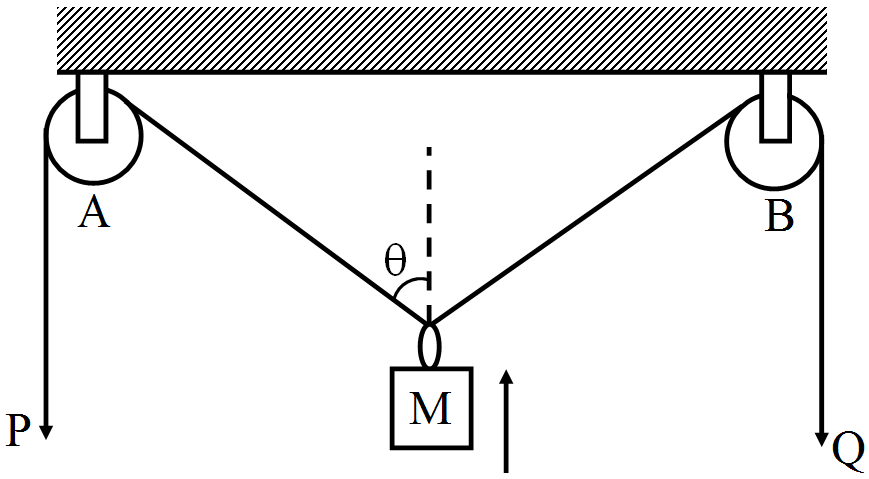
In the arrangement shown in figure, the ends P and Q of an inextensible string move downwards with uniform speed u. Pulleys A and B are fixed. The mass M moves upwards with a speed:

  1. $2\text{u}\cos\theta$

  2. $\frac{\text{u}}{\cos\theta}$

  3. $\frac{\text{2u}}{\cos\theta}$

  4. $\text{u}\cos\theta$

The coil is wound on an iron core and looped back on itself so that core has two sets of closely wound coils carrying current in opposite directions. The self inductance is.

The temperature coefficient of resistance of a conductor is

(a) Positive always

(b) Negative always

(c) Zero  

(d) Infinite

The resistance  of a conductor varies with temperature t as shown in the figure. If the variation is represented by  = , then

(a) α  and  β are both negative

(b) α and β are both positive

(c) α is positive and β is negative

(d) α is negative and β are positive