MCQ
Emf of a cell is:
  • The maximum potential difference between the terminals of a cell when no current is drawn from the cell.
  • B
    The force required to push the electrons in the circuit.
  • C
    The potential difference between the positive and negative terminal of a cell in a closed circuit.
  • D
    Less than terminal potential difference of the cell.
Answer

Correct option: A.
The maximum potential difference between the terminals of a cell when no current is drawn from the cell.

Need a full question paper?

Generate a complete, print-ready paper with questions like this in minutes — across 16+ boards, with answer keys.

Start Generating Free

Similar questions

The smallest temperature difference that can be measured with a combination of a thermocouple of thermo $\text{e.m.f.} \ 30mV$ per degree and a galvanometer of $50 \ \mathrm{ohm}$ resistance, capable of measuring a minimum current of $3 \times 10^{-7}$ amp is
 
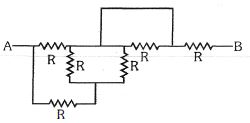
What is the equivalent resistance between  $A$ and $B$
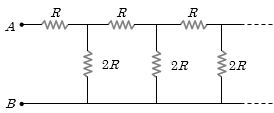
An infinite ladder network is arranged with resistances $R$ and $2 R$ as shown. The effective resistance between terminals $A$ and $B$ is
In case of linearly polarized light, the magnitude of the electric field vector :
For a thermocouple, the temperature of inversion is that temperature at which thermo e.m.f. is
If two charges of $1$ coulomb each are placed $1\ km$ apart in vacuum, the force between them will be:
At a place, the magnitudes of the horizontal component and total intensity of the magnetic field of the earth are $0.3 $ and $ 0.6$  Oersted respectively. The value of the angle of dip at this place will be.....$^o$
Two metal spheres of capacitances $C_1$ and $C_2$ carry some charges. They are put in contact and then separated. The final charges $Q_1$ and $Q_2$ on them will satisfy:
In an astronomical telescope in normal adjustment a straight black line of length $L$ is drawn on inside part of objective lens. The eye-piece forms a real image of this line. The length of this image is $I$ . The magnification of the telescope is
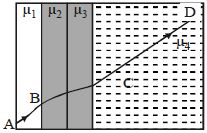
A ray of light passes through four transparent media with refractive indices $μ_1$, $μ_2$, $μ_3$ and $μ_4$ as shown in the figure. The surfaces of all media are parallel. If the emergent ray $CD$ is parallel to the incident ray $AB$, we must have