MCQ
Enthalpy change for a reaction does not depend upon
  • A
    The physical states of reactants and products
  • B
    Use of different reactants for the same product
  • The nature of intermediate reaction steps
  • D
    The differences in initial or final temperatures of involved substances
Answer

Correct option: C.
The nature of intermediate reaction steps
(c)According to Hess low, enthalpy change for a reaction does not depend on the nature of inter mediate reaction steps.

Need a full question paper?

Generate a complete, print-ready paper with questions like this in minutes — across 16+ boards, with answer keys.

Start Generating Free

Similar questions

Consider the following statements:

$(A)$ $NF _3$ molecule has a trigonal planar structure.

$(B)$ Bond length of $N _2$ is shorter than $O _2$.

$(C)$ Isoelectronic molecules or ions have identical bond order.

$(D)$ Dipole moment of $H _2 S$ is higher than that of water molecule.

Choose the correct answer from the option below:

The $pH$ of an acidic buffer mixture is
An organic compound having molecular mass $60$ is found to contain $C = 20\%$, $H= 6.67\%$ and $N=46.67\%$ while rest is oxygen. On heating it gives $N{H_3}$ along with a solid residue. The solid residue give violet colour with alkaline copper sulphate solution. the compound is
A physician wishes to prepare a buffer solution at $pH = 3.58$ that efficiently resists changes in $pH$ yet contains only small concentration of the buffering agents. Which of the following weak acids together with its sodium salt would be best to use
The process in which higher hydrocarbons are broken down into lower hydrocarbons by controlled pyrolysis, is called
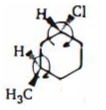
The stereochemistry of this molecule is
$\Delta {G^o}(HI,\,g) \cong + 1.7\,kJ$. What is the equilibrium constant at ${25\,^o}C$ for $2HI_{(g)} \leftrightharpoons {H_2}_{(g)} + {I_2}_{(g)}$
$HgCl_2$ is a covalent compound, sparingly soluble in water, the solubility increases by the addition of chloride ions due to
${C_6}{H_5} - C{H_3}\xrightarrow{{KMn{O_4}}}A\xrightarrow[\Delta ]{{NaOH + CaO}}B,$ product $B$ is
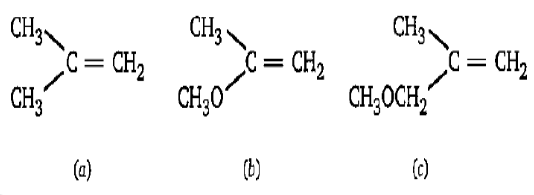
Arrange the above in the decreasing order of reactivity towards HBr: