MCQ
Enthalpy $(H)$ is equal to
- AInternal energy
- BProduct of pressure $(P) $ and volume $ (V) $ of gas
- ✓Internal energy $(E)+PV$
- DWork $ (W)$ done by a system
Generate a complete, print-ready paper with questions like this in minutes — across 16+ boards, with answer keys.
$2 A ( g ) \rightleftharpoons A _{2}( g )$
at $400\, K$ has $\Delta G ^{\circ}=+25.2\, kJ mol ^{-1}$.
The equilibrium constant $K _{ C }$ for this reaction is $...... \times 10^{-2}$. (Round off to the Nearest integ $\left[\right.$ Use $: R=8.3\, J mol ^{-1} K ^{-1}, \ln 10=2.3$
$\left.\log _{10} 2=0.30,1\, atm =1\, bar \right]$
$[$ antilog $(-0.3)=0.501]$
$A$. Compound ' $B$ ' is aromatic
$B$. The completion of above reaction is very slow
$C$. '$A$' shows tautomerism
$D$. The bond lengths $C - C$ in compound $B$ are found to be same
Choose the correct answer from the options given below :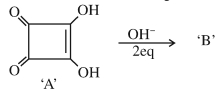
$\begin{array}{*{20}{c}}
{R = - CH - Cl}\\
{|\,\,}\\
{\,\,\,\,C{H_3}}
\end{array}\,\,\,\,,\,\,\,\,\,\,\,\,\,\,\begin{array}{*{20}{c}}
{S = - CH - Cl}\\
{|\,\,}\\
{Br}
\end{array}$
A for precipitate formation reaction.
B for precipitate dissolution reaction.
C for precipitate exchange reaction.
D for no reaction.
${P_4} + NaOH \longrightarrow P{H_3} \uparrow + Na{H_2}P{O_2}$
$CH_3-CH = CH -CH_2 -CH_2 -CH(CH_3)_2$
$(A)$ $(B)\,\,\,(C)$ $(D)$ $(E)\,\,\,(F)$
arrange them in decreasing order of reactivity towards free radical substitution