Question
Enumerate the points that have to be considered for successful bee-keeping.

Answer

Bee-keeping (Apiculture):
  • The maintenance of hives of honeybees for the production of honey is termed bee-keeping or apiculture.
  • Bee-keeping is practiced in any area where there is availability of sufficient bee pastures of some wild shrubs, fruit orchards and cultivated crops.
  • Among several species of honeybees, one of the most common that can be reared is Apis indica.
  • A successful bee-keeping requires,
  1. Knowledge of the nature and habits of bees.
  2. Selection of a suitable location for keeping the beehives.
  3. Catching and hiving of swarms (groups of bees).
  4. Management of beehives during different seasons.
  5. Handling and collection of honey and beeswax.
Ecological Importance of Bees: Bees are the pollinators of many crop species like sunflower, Brassica, apple and pear. So keeping beehives in crop fields during flowering period increases both crop yield and honey yield.
Commercial Importance of Bees:
  1. Honey is used as food of very high nutritive value.
  2. Honey is also used in the indigenous system of medicines.
  3. Beeswax produced by honeybees is used in industry to prepare cosmetics and polishes.

Need a full question paper?

Generate a complete, print-ready paper with questions like this in minutes — across 16+ boards, with answer keys.

Start Generating Free

Similar questions

Give reasons:
(a) Oxytocin is 'birth hormone'.
(b) People living in hilly region are advised to use iodised salt.
(c) Old age persons show weakened immune response.
(d) Pancreas is a dual gland.
With the help of a suitable diagram, describe the conducting system of human heart.
Discuss the mode of action and advantages/ disadvantages of hormonal contraceptives.
Long Answer Questions
What is parthenogenesis? Explain the haplodiploid method of sex determination in honey bee.
Differentiate between an inbred line and a hybrid variety of crop. Explain the steps involved in the production of the hybrid variety.
  1. State one difference and one similarity between geitonogamy and xenogamy.
  2. Explain any three devices developed in flowering plants to discourage self pollination and encourage cross-pollination.
Discuss the clinical manifestation of AIDS.
Fill in the blanks,
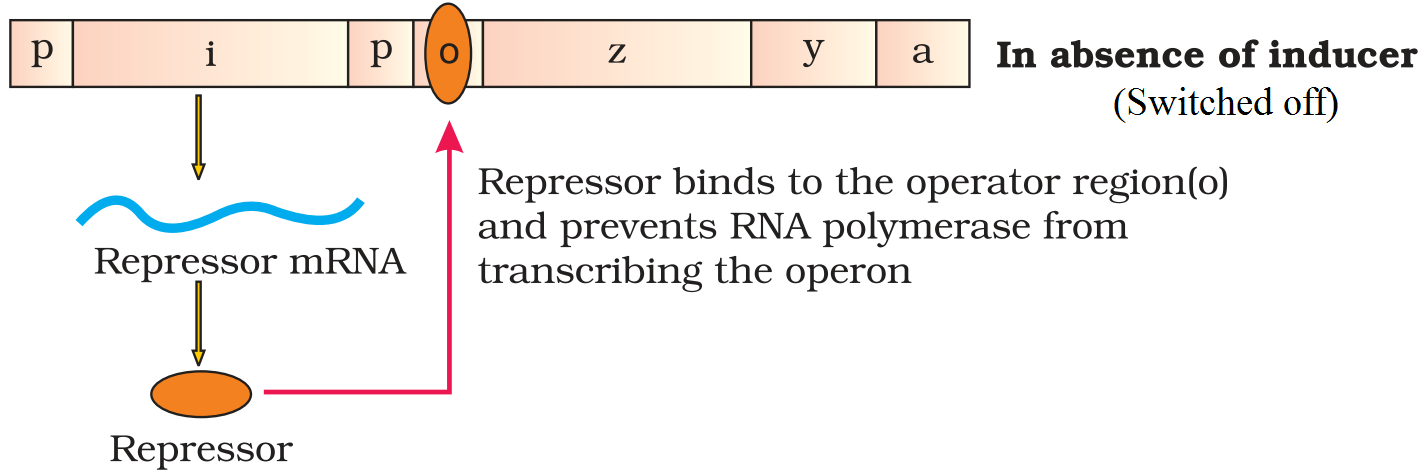
Look at the figure below depicting lac operon of E.coli.
  1. What could be the series of events when an inducer is present in the medium in which E. coli is growing?
  2. Name the Inducer.
Read the following and answer any four questions from (i) to (v) given below:
Transgenic animals can serve as factories that in some cases, may produce large amount of proteins more efficiently. Transgenic mice have been engineered to express human antibodies by introducing large segment of human DNA encoding human immunoglobulin genes. In transgenic large animals such as cow or sheep proteins of pharmaceutical value can be produced in large quantities in milk which is later purified. Transgenesis can be used to alter many phenotypic properties including growth rate, fat composition, milk production, hair texture, etc.
  1. The production of transgenic animals includes
  1. Identification and separation of desired gene.
  2. Combining the desired gene with appropriate vector.
  3. Introduction of vector in cells, tissues or embryos.
  4. All of these.
  1. In transgenic animals, i.e., cow and sheep proteins of pharmaceutical value are produced in large quantities in the
  1. Blood.
  2. Accumulated fat.
  3. Mammary glands.
  4. None of these.
  1. Mouse is mostly preferred animal for studies on gene transfer because.
  1. Short oestrous cycle.
  2. Long gestation period.
  3. Short generation time.
  4. Production of one or two offspring per pregnancy.
  1. Both (A) and (C)
  2. Both (A) and (B)
  3. Only D
  4. Both (C) and (D).
  1. Transgenic genes alter many phenotypic properties including:
  1. Growth rate.
  2. Fat composition.
  3. Milk production.
  4. All of these.
  1. Assertion: Transgenic mice have been engineered to express human antibodies.
Reason: Large segment of human DNA encoding human immunoglobulin have been transferred to mice.
  1. Both assertion and reason are true and reason is the correct explanation of assertion.
  2. Both assertion and reason are true but reason is not the correct explanation of assertion.
  3. Assertion is true but reason is false.
  4. Both assertion and reason are false.