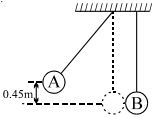
Question
Equal torques act on the discs A and B of the previous problem, initially both being at rest. At a later instant, the linear speeds of a point on the rim of A and another point on the rim of B are vA and vB respectively. We have:
  1. vA > vB
  2. vA = vB
  3. vA < vB
  4. The relation depends on the actual magnitude of the torques.
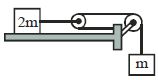
Answer

  1. vA > vB

Explanation:

$\tau=\text{I}\alpha$ (Magnitude)

For equal torque, we have:

$\text{I}_{\text{A}\propto\text{A}}=\text{I}_{\text{B}\propto\text{B}}$

$\text{I}_{\text{A}}<\text{I}_{\text{B}}$

$\Rightarrow\alpha_{\text{A}}>\alpha_{\text{B}}\ \dots(\text{i})$

Now, $\omega=\alpha\text{t}$

Or, $\frac{\text{v}}{\text{r}}=\alpha\text{t}$

$\text{v}_{\text{A}}>\text{v}_{\text{B}}$ [Using (i)]

Need a full question paper?

Generate a complete, print-ready paper with questions like this in minutes — across 16+ boards, with answer keys.

Start Generating Free

Similar questions

A circular plate of uniform thickness of diameter $56\, cm$, whose center is at origin. A circular part of diameter $42\, cm$ is removed from one edge. What is the distance of the centre of mass of the remaining part ........ $cm.$
A standing wave exists in a string of length $150\ cm$ , which is fixed at both ends with rigid supports . The displacement amplitude of a point at a distance of $10\ cm$ from one of the ends is $5\sqrt 3\ mm$ . The nearest distance between the two points, within the same loop and havin displacment amplitude equal to $5\sqrt 3\  mm$ is $10\ cm$ . Find the maximum displacement amplitude of the particles in the string .... $mm$
Following graph shows the correct variation in intensity of heat radiations by black body and frequency at a fixed temperature
A metre stick is pivoted about its centre. A piece of wax of mass $20 \,g$ travelling horizontally and perpendicular to it at $5 \,m / s$ strikes and adheres to one end of the stick so that the stick starts to rotate in a horizontal circle. Given the moment of inertia of the stick and wax about the pivot is $0.02 \,kg m ^2$, the initial angular velocity of the stick is ........... $rad / s$
The equation of a travelling wave is $y = 60\cos (1800t - 6x)$ where $y$ is in microns, $t$ in seconds and $x$ in metres. The ratio of maximum particle velocity to velocity of wave propagation is
The velocity of a small ball of mass $\mathrm{M}$ and density $d,$ when dropped in a container filled with glycerine becomes constant after some time. If the density of glycerine is $\frac{\mathrm{d}}{2}$, then the viscous force acting on the ball will be :
Consider the situation shown in figure. All the surfaces are smooth. The tension in the string connected to $2\,m$ is
In which of the following cases forces may not be required to keep the
Two massless string of length $5\, m$ hang from the ceiling very near to each other as shown in the figure. Two balls $A$ and $B$ of masses $0.25 \,kg$ and $0.5 \,kg$ are attached to the string. The ball $A$ is released from rest at $a$ height $0.45\, m$ as shown in the figure. The collision between two balls is completely elastic. Immediately after the collision, the kinetic energy of ball $B$ is $1\, J$. The velocity of ball $A$ just after the collision is
A hydraulic automobile lift is designed to lift vehicles of mass $5000\,kg$. The area of cross section of the cylinder carrying the load is $250\,cm ^2$. The maximum pressure the smaller piston would have to bear is [Assume $g=10\,m / s ^2$]