MCQ
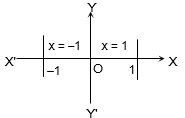
Equation of a circle whose centre is origin and radius is equal to the distance between the lines $x = 1$ and $x = - 1$ is
  • A
    ${x^2} + {y^2} = 1$
  • B
    ${x^2} + {y^2} = \sqrt 2 $
  • ${x^2} + {y^2} = 4$
  • D
    ${x^2} + {y^2} = - 4$

Answer

Correct option: C.
${x^2} + {y^2} = 4$
c
(c) Radius = $2, C\ (0, 0)$

Equation of circle can be found from this.
Need a full question paper?

Generate a complete, print-ready paper with questions like this in minutes — across 16+ boards, with answer keys.

Start Generating Free

Similar questions

The value of$\cos1^\circ\cos2^\circ\cos^\circ...\cos179$ is:
The number of irrational terms in the expansion of $\Big(4^{\frac{1}{5}}+7^{\frac{1}{10}}\Big)^{45}$ is:
​​​​​​
The mean age of $25$ teachers in a school is $40$ years. A teacher retires at the age of $60$ years and a new teacher is appointed in his place. If the mean age of the teachers in this school now is $39$ years, then the age (in years) of the newly appointed teacher is..........
If $cos A = {3\over 4} , $ then $32\sin \left( {\frac{A}{2}} \right)\sin \left( {\frac{{5A}}{2}} \right) = $
The centre of a regular polygon of $n$ sides is located at the point $z = 0$ and one of its vertex ${z_1}$ is known. If ${z_2}$ be the vertex adjacent to ${z_1}$, then ${z_2}$ is equal to
If ${z_1},{z_2},{z_3}......{z_n}$ are nth, roots of unity, then for $k = 1,\,2,.....,n$
In a box, there are $20$ cards, out of which $10$ are lebelled as $\mathrm{A}$ and the remaining $10$ are labelled as $B$. Cards are drawn at random, one after the other and with replacement, till a second $A-$card is obtained. The probability that the second $A-$card appears before the third $B-$card is
The houses on one side of a road are numbered using consecutive even numbers. The sum of the numbers of all the houses in that row is $170$ . If there are at least $6$ houses in that row and $a$ is the number of the sixth house, then
The solution of $\Big|\frac{2}{(\text{x} – 4)}\Big|>1$ where $\text{x}\neq4$ is:
$5$ persons $A, B, C, D$ and $E$ are in queue of a shop. The probability that $A$ and $E$ always together, is