MCQ
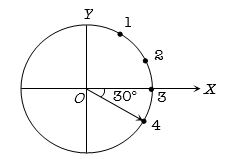
Equation of the hour hand at $4$ O’ clock is
  • A
    $x - \sqrt 3 \;y = 0$
  • B
    $\sqrt 3 \;x - y = 0$
  • $x + \sqrt 3 \;y = 0$
  • D
    $\sqrt 3 \;x + y = 0$

Answer

Correct option: C.
$x + \sqrt 3 \;y = 0$
c
(c) Since the hour, minute and second hands always pass through origin because one end of these hands is always at origin. Now at $4$ O’ clock, the hour hand makes ${30^o}$angle in fourth quadrant. So the equation of hour hand is

$y = mx \Rightarrow y = - \frac{1}{{\sqrt 3 }}x$

$ \Rightarrow x + \sqrt 3 y = 0$.
Need a full question paper?

Generate a complete, print-ready paper with questions like this in minutes — across 16+ boards, with answer keys.

Start Generating Free

Similar questions

The sum of the co-efficients of all odd degree terms in the expansion of  ${\left( {x + \sqrt {{x^3} - 1} } \right)^5} + {\left( {x - \sqrt {{x^3} - 1} } \right)^5},\left( {x > 1} \right)$ 
The roots of the equation

$x^5 - 40x^4 + px^3 + qx^2 + rx + s = 0$ are in $G.P.$ The sum of their reciprocals is $10$. Then the value of $\left| s \right|$ is

The number of integral values of $k$, for which one root of the equation $2 x^2-8 x+k=0$ lies in the interval $(1,2)$ and its other root lies in the interval $(2,3)$, is :
The co-ordinates of the foci of the ellipse $3{x^2} + 4{y^2} - 12x - 8y + 4 = 0$ are
If $\mathop {\lim }\limits_{x \to 0} \frac{{[(a - n)\,nx - \tan x]\sin nx}}{{{x^2}}} = 0,$ where $n$ is non zero real number, then $a$ is equal to
Given that $4^{th}$ term in the expansion of ${\left( {2 + \frac{3}{8}x} \right)^{10}}$ has the maximum numerical value, the range of value of $x$ for which this will be true is given by
An unbiased coin is tossed eight times. The probability of obtaining at least one head and at least one tail is
Let $\Gamma$ be a circle with diameter $A B$ and centre $O$. Let $l$ be the tangent to $\Gamma$ at $B$. For each point $M$ on $\Gamma$ different from $A$, consider the tangent $t$ at $M$ and let interest $l$ at $P$. Draw a line parallel to $A B$ through $P$ intersecting $M M$ at $Q$. The locus of $Q$ as $M$ varies over $\Gamma$ is
If A lies in second quadrant $3\tan\text{A}+4=0,$ then the value of $2\cot\text{A}-5\cot\text{A}+\sin\text{A}$ is:
If ${(1 + x)^n} = \sum\limits_{r = 0}^n {{C_r}{x^r}} $, then $\left( {1 + \frac{{{C_1}}}{{{C_0}}}} \right)\,\left( {1 + \frac{{{C_2}}}{{{C_1}}}} \right)....\left( {1 + \frac{{{C_n}}}{{{C_{n - 1}}}}} \right) = $