Question
Equipotential surfaces are 5 cm apart from each other. How much work will be required to move a 500 µC charge between distant points?

Answer

Potential difference between any two points on the post-isopotential surface $\Delta V =$ zero
Therefore work $W =$ charge $q \times$ potential difference $(\Delta V )$$=100 \mu C \times 0=\text { zero }$
i.e, no work has to be done.

Need a full question paper?

Generate a complete, print-ready paper with questions like this in minutes — across 16+ boards, with answer keys.
Start Generating Free

Similar questions

Plot a graph showing variation of de-Broglie wavelength $\lambda$ versus $\frac{1}{\sqrt{V}} ,$ where V is accelerating potential for two particles A and B carrying same charge but of masses m1, m2 (m1 > m2). Which one of the two represents a particle of smaller mass and why?
A uranium-238 nucleus, initially at rest, emits an alpha particle with a speed of 1.4 x 10⁷m/s. Calculate the recoil speed of the residual nucleus thorium-234. Assume that the mass of a nucleus is proportional to the mass number.
A park has a radius of 10m. If a vehicle goes round it at an average speed of 18km/ hr, what should be the proper angle of banking?
The current in the forward bias is known to be more $(\sim\mu\text{A})$ than the current in the reverse bias $(\sim\mu\text{A})$.What is the reason, then, to operate the photodiode in reverse bias?
Write down the difference between a half wave rectifier and a full wave rectifier.
The electric potential inside a charged spherical ball is given by $\phi=a r^2+b$. Where $r$ is the distance from the centre, $a$ and $b$ are constants. Calculate the charge density inside the ball.
Is it possible to add two vectors of unequal magnitudes and get zero? Is it possible to add three vectors of equal magnitudes and get zero?
What is the radius of the path of an electron (mass $9 \times 10^{-31} kg$ and charge $1.6 \times 10^{-19} C$ ) moving at a speed of $3 \times 10^7 m / s$ in a magnetic field of $6 \times 10^{-4} T$ perpendicular to it? What is its frequency? Calculate its energy in $keV .\left(1 eV =1.6 \times 10^{-19} J \right)$.
The force between two point charges kept at a distance r apart in air is F. If the same charges are kept in water at the same distance, how does the force between them change?
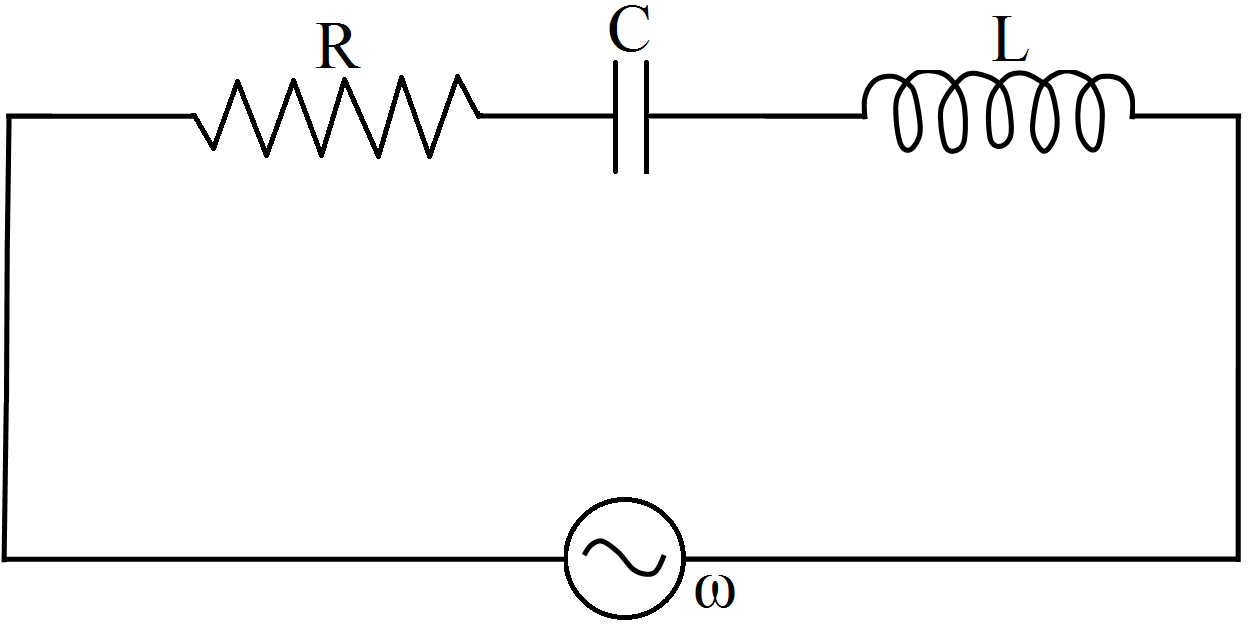
In the circuit shown below R represents an electric bulb. If the frequency $\text{v}=\Big(\frac{\omega}{2\pi}\Big)$ of the supply is doubled, how should the values of C and L be changed, so that the glow of bulb remains unchanged?