Question
Equipotential surfaces:

Answer

  1. Are closer in regions of large electric fields compared to regions of lower electric fields.
  2. Will be more crowded near sharp edges of a conductor.
  3. Will be more crowded near regions of large charge densities.
Equipotential surfaces are closer in regions of large electric fields because electric field intensity is inversely proportional to the separation between equipotential surfaces. 
As the electric field intensities is large near sharp edges of a charged conductor or near the regions of large charge densities. Therefore, numbers of equipotential surfaces are closer to such places or in other words they are more crowded.

Need a full question paper?

Generate a complete, print-ready paper with questions like this in minutes — across 16+ boards, with answer keys.
Start Generating Free

Similar questions

Two identical conductors of copper and aluminium are placed in an identical electric fields. The magnitude of induced charge in the aluminium will be(a) Zero  (b) Greater than in copper(c) Equal to that in copper(d) Less than in copper
   
   
In Young's double slit experiment when wavelength used is 6000 Å and the screen is 40 cm from the slits, the fringes are 0.012 cm wide. What is the distance between the slits(a) 0.024 cm(b) 2.4 cm(c) 0.24 cm(d) 0.2 cm
       
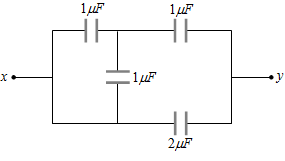
Four capacitors are connected as shown in the figure. Their capacities are indicated in the figure. The effective capacitance between points $x$  and $y$  is $($in $μF)$
Digital signals are :
The hyper-metropia is a(a) Short-side defect(b) Long- side defect(c) Bad vision due to old age(d) None of these
   
   
1 amu (u) is equivalent to :
Work of moderator is(a) To control the velocity of neutrons(b) Cooling(c) As fuel(d) It is used for safety
   
   
If the refractive indices of crown glass for red, yellow and violet colours are 1.5140, 1.5170 and 1.5318 respectively and for flint glass these are 1.6434, 1.6499 and 1.6852 respectively, then the dispersive powers for crown and flint glass are respectively(a) 0.034 and 0.064(b) 0.064 and 0.034(c) 1.00 and 0.064(d) 0.034 and 1.0
       
The subatomic particle that is emitted from a metal surface, when it is heated is a/an _________:
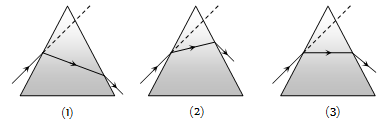
The figures represent three cases of a ray passing through a prism of angle $A.$ The case corresponding to minimum deviation is