Question
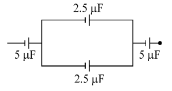
Equivalence in the following circuit is:
Image

Answer

(a)$\frac{5}{3} \mu F$

Need a full question paper?

Generate a complete, print-ready paper with questions like this in minutes — across 16+ boards, with answer keys.
Start Generating Free

Similar questions

The electrons are emitted in the photoelectric effect from a metal surface          (a) Only if the frequency of the incident radiation is above a certain threshold value(b) Only if the temperature of the surface is high(c) At a rate that is independent of the nature of the metal(d) With a maximum velocity proportional to the frequency of the incident radiation


An electron of mass $m$ when accelerated through a potential difference $V$ has de$-$Broglie wavelength $\lambda .$ The de$-$Broglie wavelength associated with a proton of mass $M$ accelerated through the same potential difference will be
The magnetic susceptibility is negative for:
  1. Pramagnetic materials only.
  2. Diamagnetic materials only.
  3. Ferromagnetic materials only.
  4. Paramagnetic and ferromagnetic materials.
A battery of e.m.f. 3 volt and internal resistance 1.0 ohm is connected in series with copper voltameter. The current flowing in the circuit is 1.5 amperes. The resistance of voltameter will be(a) Zero(b) 1.0 ohm(c) 1.5 ohm(d) 2.0 ohm
       
All particles of a wave front vibrate:
A circular loop of area $1\ cm^2,$ carrying a current of $10A,$ is placed in a magnetic field of $0.1T$ perpendicular to the plane of the loop. The torque on the loop due to the magnetic field is:
Assertion : According to classical theory, the proposed path of an electron in Rutherford atom model will be parabolic.
Reason     : According to electromagnetic theory an accelerated particle continuously emits radiation.(a) If both assertion and reason are true and the reason is the correct explanation of the assertion.(b) If both assertion and reason are true but reason is not the correct explanation of the assertion.(c) If assertion is true but reason is false.(d) If assertion is false but reason is true.


The wavefronts of a light wave travelling in vacuum are given by $x + y + z = c.$ The angle made by the direction of propagation of light with the $X-$axis is$:$
Although we can know with great precision the pattern formed by huge numbers of photons passing through the lines on a diffraction grating, we cannot know at all where one single photon will go when it passes through the diffraction grating.
This statement describes the truth revealed by what theory?
If $\varepsilon_0$ and $\mu_0$ are respectively, the electric permittivity and the magnetic permeability of free space, $\varepsilon$ and $\mu$ the corresponding quantities in a medium, the refractive index of the medium is