Question
Equivalent capacitance between A and B is
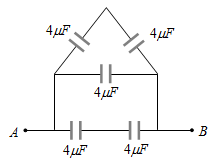
|
(a) 8 μC |
(b) 6 μF |
(c) 26 μF |
(d) 10/3 μF |
Equivalent capacitance between A and B is
|
(a) 8 μC |
(b) 6 μF |
(c) 26 μF |
(d) 10/3 μF |
(a) 8 μC
Generate a complete, print-ready paper with questions like this in minutes — across 16+ boards, with answer keys.
Assertion : Charge is invariant.
Reason : Charge does not depends on speed of frame of reference.
|
(a) If both assertion and reason are true and the reason is the correct explanation of the assertion. |
|
(b) If both assertion and reason are true but reason is not the correct explanation of the assertion. |
|
(c) If assertion is true but reason is false. |
|
(d) If the assertion and reason both are false. |
The phase difference between input and output voltages of a CE circuit is
|
(a) 0o |
(b) 90o |
(c) 180o |
(d) 270o |
Consider the following two statements A and B and identify the correct choice given in the answers
(A) Duddells thermo-galvanometer is suitable to measure direct current only
(B) Thermopile can measure temperature differences of the order of 
|
(a) Both A and B are true |
(b) Both A and B are false |
|
(c) A is true but B is false |
(d) A is false but B is true |
In double slit experiment, the angular width of the fringes is 0.20o for the sodium light (λ =5890 Å). In order to increase the angular width of the fringes by 10%, the necessary change in the wavelength is
|
(a) Increase of 589 Å |
(b) Decrease of 589 Å |
(c) Increase of 6479 Å |
(d) Zero |
The distance between the body centred atom and a corner atom in sodium (a = 4.225 Å) is
|
(a) 3.66 Å |
(b) 3.17 Å |
(c) 2.99 Å |
(d) 2.54 Å |
Two short magnets with their axes horizontal and perpendicular to the magnetic meridian are placed with their centres 40 cm east and 50 cm west of magnetic needle. If the needle remains undeflected, the ratio of their magnetic moments  is
is
|
(a) 4 : 5 |
(b) 16 : 25 |
(c) 64 : 125 |
(d) 2 : |
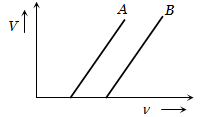
The stopping potential as a function of the frequency of the incident radiation is plotted for two different photoelectric surfaces A and B. The graphs show that work function of A is
|
(a) Greater than that of B |
|
(b) Smaller than that of B |
|
(c) Equal to that of B |
|
(d) No inference can be drawn about their work functions from the given graphs |
