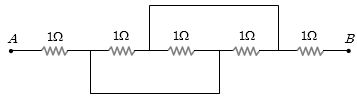
Equivalent resistance between the points $A$ and $B$ is (in $\Omega$)
Easy


Download our appand get started for free
Experience the future of education. Simply download our apps or reach out to us for more information. Let's shape the future of learning together!No signup needed.*
Similar Questions
- 1View SolutionElectromotive force is the force, which is able to maintain a constant
- 2A null point is found at $200\,cm$ in potentiometer when cell in secondary circuit is shunted by $5\,\Omega$. When a resistance of $15\,\Omega$ is used for shunting null point moves to $300\,cm$. The internal resistance of the cell is $..............\,\Omega$.View Solution
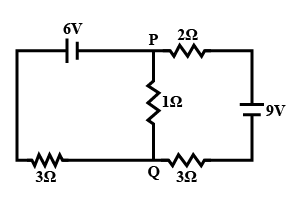
- 3In the circuit shown, the current in the $1\,\Omega$ resistor isView Solution
- 4If current in an electric bulb changes by $1\%$, then the power will change by ............ $\%$View Solution
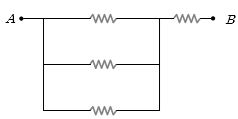
- 5If all the resistors shown have the value $2\, ohm$ each, the equivalent resistance over $AB$ isView Solution
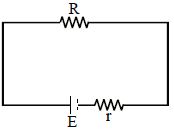
- 6$n$ equal cell having emf $E$ and internal resistance $r$, are connected in a circuit of a resistance $R$ . Same current flows in circuit either they are connected in series or parallel, ifView Solution
- 7A cylindrical copper rod has length $L$ and resistance $R$. If it is melted and formed into another rod of length $2 L$, then the resistance will be ....... $R$View Solution
- 8A set of $n$ equal resistors, of value $R$ each, are connected in series to a battery of emf $E$ and internal resistance $R.$ The current drawn is $I.$ Now, the $n$ resistors are connected in parallel to the same battery. Then the current drawn from battery becomes $10\,I.$ The value of $n$ isView Solution
- 9If power in external resistance $R$ is maximum thenView Solution
$(i) R = r$ $(ii)$ Power in $R$ is $\frac{{{E^2}}}{{4R}}$
$(iii)$ Input power $\frac{{{E^2}}}{{2R}}$ $(iv)$Efficiency is $50\%$
- 10Two sources of equal $emf$ are connected to an external resistance $R$. The internal resistances of the two sources are ${R_1}$ and ${R_2}\,({R_2} > {R_1})$. If the potential difference across the source having internal resistance ${R_2}$ is zero, thenView Solution