MCQ
$Erg - {m^{ - 1}}$ can be the unit of measure for
  • Force
  • B
    Momentum
  • C
    Power
  • D
    Acceleration

Answer

Correct option: A.
Force
a
(a) Energy $(E) = F × d $

$⇒$  $F = \frac{E}{d}$

so Erg/metre can be the unit of force.

Need a full question paper?

Generate a complete, print-ready paper with questions like this in minutes — across 16+ boards, with answer keys.
Start Generating Free

Similar questions

A particle projected from origin moves in $x-y$ plane with a velocity $\vec{v}=3 \hat{i}+6 x \hat{j}$, where $\hat{i}$ and $\hat{j}$ are the unit vectors along $x$ and $y$ axis. Find the equation of path followed by the particle
A particle moves along an arc of a circle of radius $R$ . Its velocity depends on the distance covered as $v = a\sqrt s$ , where $a$ is a constant then the angle $\alpha $ between the vector of the total acceleration and the vector of velocity as a function of $s$ will be
The property of a body by virtue of which it tends to regain its original size and shape of a body when applied force is removed, is known as:
A large drop of oil (density $0.8\,g / cm ^3$ and viscosity $\eta_0$) floats up through a column of another liquid (density $1.2\,g / cm ^3$ and viscosity $\eta_L$ ). Assuming that the two liquids do not mix, the velocity with which the oil drop rises will depend on.
Time period of a simple pendulum is $T$ inside a lift when the lift is stationary. If the lift moves upwards with an acceleration $g / 2,$ the time period of pendulum will be
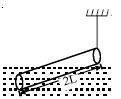
A slender homogeneous rod of length $2L$ floats partly immersed in water, being supported by a string fastened to one of its ends, as shown. The specific gravity of the rod is $0.75$. The length of rod that extends out of water is : 
Consider the following two statements:
$A.$ Linear momentum of the system remains constant.
$B.$ Centre of mass of the system remains at rest.
A particle is projected from the mid-point of the line joining two fixed particles each of mass $m.$ If the distance of separation between the fixed particles is $l,$ the minimum velocity of projection of the particle so as to escape is equal to
A ball is allowed to fall from a height of $10 \,m$. If there is $40 \%$ loss of energy due to impact, then after one impact ball will go up by ........ $m$
A body of mass $m$ kg. starts falling from a point $2R$ above the Earth’s surface. Its kinetic energy when it has fallen to a point $‘R’$ above the Earth’s surface [$R-$Radius of Earth, $M-$Mass of Earth, $G-$Gravitational Constant]