Question
Escape velocity on the earth

Answer

(d) ${v_e} = \sqrt {\frac{{2GM}}{{(R + h)}}} $

Need a full question paper?

Generate a complete, print-ready paper with questions like this in minutes — across 16+ boards, with answer keys.
Start Generating Free

Similar questions

The linear mass density $(\lambda)$ of a rod of length $L$ kept along $x$-axis varies as $\lambda=\alpha+\beta x$; where $\alpha$ and $\beta$ are positive constants. The centre of mass of the rod is at ..........
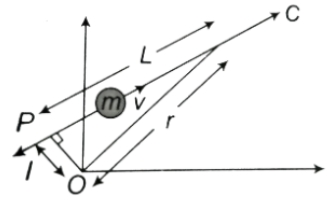
A particle of mass $m$ moves along line $PC$ with velocity $v$ as shown.  What is the angular momentum of the particle about $O$ ​
A direct current of $4\,A$ and an alternating current of peak value $4\,A$ flow through resistance of $3\,\Omega$ and $2\,\Omega$ respectively. The ratio of heat produced in the two resistances in same interval of time will be.
If number of turns per unit length of a coil of solenoid is doubled, the self-inductance of the solenoid will
When a mixture of methane and oxygen is passed through heated molybdenum oxide, the main product formed is
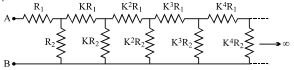
The circuit diagram shown consists of a large number of element (each element has two resistors $R_1$ and $R_2$). The resistance of the resistors in each subsequent element differs by $a$ factor of $K = 1/2$ from the resistance of the resistors in the previous elements. The equivalent reistance between $A$ and $B$ shown in figure is :
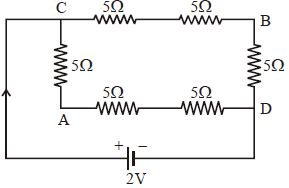
In the adjoining circuit shown the potential difference between points $A$ and $B$ will be
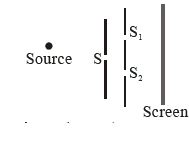
 In Young's double slit experiment, if width (aperture) of the slit $S$ is increased keeping other parameters constant, then the interference fringes will 
A particle starts its motion from rest under the action of a constant force. If the distance covered in first $10$ seconds is $S_1$ and that covered in the first $20$ seconds is $S_2$ , then
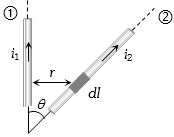
Wires $1$ and $2$ carrying currents ${i_1}$ and ${i_2}$respectively are inclined at an angle $\theta $ to each other. What is the force on a small element $dl$ of wire $2$ at a distance of $r$ from wire $1$ (as shown in figure) due to the magnetic field of wire $1$