Question
Establish a relation between electric current and drift velocity.

OR

Prove that the current density of a metallic conductor is directly proportional to the drift speed of electrons.
Answer

Relation between electric current and drift velocity:

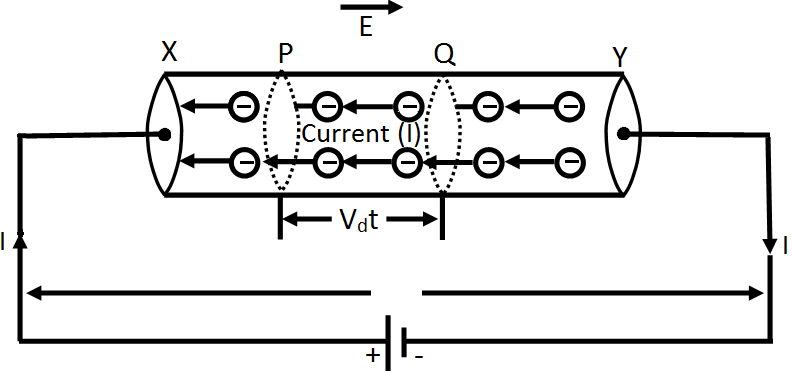
Consider a uniform metallic wire XY of length l and cross-sectional area A. A potential difference V is applied across the ends X and Y of the wire. This causes an electric field at each point of the wire of strength.

$\text{E}=\frac{\text{V}}{\text{l}}\dots\text{(i)}$

Due to this electric field, the electrons gain a drift velocity vd opposite to direction of electric field. If q be the charge passing through the cross-section of wire in t seconds, then

$\text{Current in write I}=\frac{\text{q}}{\text{r}}\dots\text{(ii)}$

The distance traversed by each electron in time t = average velocity × time = vd t

If we consider two planes P and Q at a distance vd t in a conductor, then the total charge flowing in time t will be equal to the total charge on the electrons present within the cylinder PQ.

The volume of this cylinder = cross sectional area × height = A vd t

If n is the number of free electrons in the wire per unit volume, then the number of free electrons

in the cylinder = n(Avd t)

If charge on each electron is -e (e = 1.6 × 10⁻¹⁹C), then the total charge flowing through a cross-section of the wire

q = (nAvd t) (-e) = –neAvd t ...(iii)

$\therefore$ Current flowing in the wire,

$\text{I}=\frac{\text{q}}{\text{t}}=\frac{-\text{v}}{\text{t}}$

i.e., current I = -neAvd ...(iv)

This is the relation between electric current and drift velocity. Negative sign shows that the direction of current is opposite to the drift velocity.

Numerically I = -neAvd ...(v)

$\therefore$ Current density, $\text{J}=\frac{\text{I}}{\text{A}}=\text{d}$

$\Rightarrow\text{J}\propto\text{vd.}$

That is, current density of a metallic conductor is directly proportional to the drift velocity.

Need a full question paper?

Generate a complete, print-ready paper with questions like this in minutes — across 16+ boards, with answer keys.
Start Generating Free

Similar questions

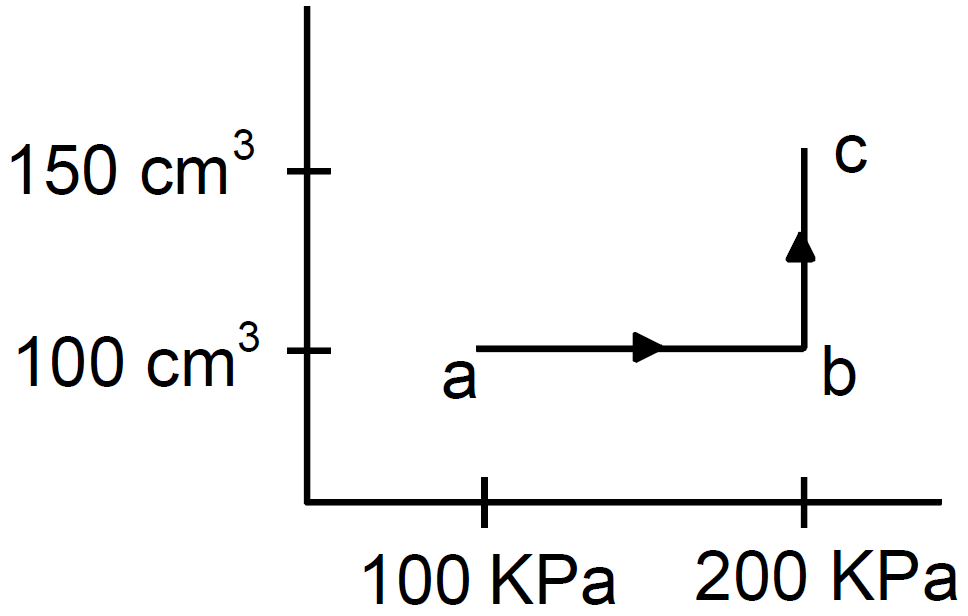
An ideal gas $(\gamma=1.67)$ is taken through the process abc shown in the figure. The temperature at point a is 300K. Calculate,
  1. The temperatures at b and c.
  2. The work done in the process.
  3. The amount of heat supplied in the path ab and in the path bc.
  4. The change in the internal energy of the gas in the process.

The current in a discharging LR circuit without the battery drops from 2.0A to 1.0A in 0.10s.
  1. Find the time constant of the circuit.
  2. If the inductance of the circuit is 4.0H, what is its resistance?
Write Einstein's photoelectric equation and explain any two observations related to the photoelectric effect.
Two identical balls, each having a charge of 2.00 × 10-7C and a mass of 100g, are suspended from a common point by two insulating strings each 50cm long. The balls are held at a separation 5.0cm apart and then released. Find,
  1. The electric force on one of the charged balls.
  2. The components of the resultant force on it along and perpendicular to the string.
  3. The tension in the string.
  4. The acceleration of one of the balls. Answers are to be obtained only for the instant just after the release.
A $20\mu\text{F}$ capacitor is joined to a battery of emf 6.0V through a resistance of $100\Omega.$ Find the charge on the capacitor 2.0ms after the connections are made.
In an experiment with Foucault's apparatus, the various distances used are as follows:
Distance between the rotating and the fixed mirror = 16m
Distance between the lens and the rotating mirror = 6m
Distance between the source and the lens = 2m
When the mirror is rotated at a speed of 356 revolutions per second, the image shifts by 0.7mm. Calculate the speed of light from these data.
Air is pumped into the tubes of a cycle rickshaw at a pressure of 2 atm. The volume of each tube at this pressure is 0.002m3. One of the tubes gets punctured and the volume of the tube reduces to 0.0005m3. How many moles of air have leaked out? Assume that the temperature remains constant at 300K and that the air behaves as an ideal gas.
  1. Describe briefly, with the help of a diagram, the role of the two important processes involved in the formation of a p-n junction.
  2. Name the device which is used as a voltage regulator. Draw the necessary circuit diagram and explain its working.
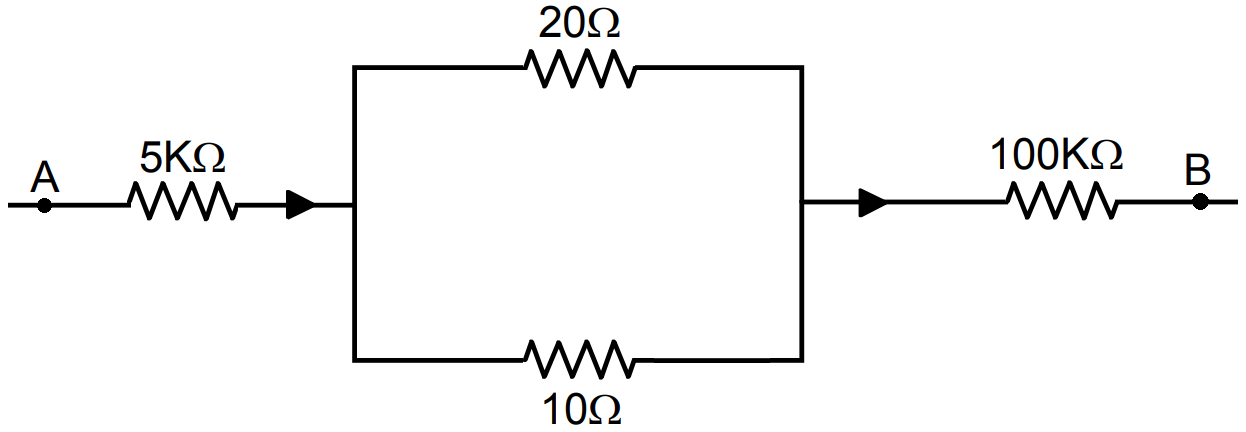
Figure. shows a part of a circuit. If a current of 12mA exists in the $5\text{k}\Omega$ resistor, find the currents in the other three resistors. What is the potential difference between the points A and B?

What is the difference between cathode rays and beta rays? When the two are travelling in space, can you make out which is the cathode ray and which is the beta ray?