Question
Establish a relationship between torque ( $\tau$ ), moment of inertia (I) and angular acceleration ( $\alpha$ ).

Answer

self

Need a full question paper?

Generate a complete, print-ready paper with questions like this in minutes — across 16+ boards, with answer keys.

Start Generating Free

Similar questions

A 100kg gun fires a ball of 1kg horizontally from a cliff of height 500m. It falls on the ground at a distance of 400m from the bottom of the cliff. Find the recoil velocity of the gun. (acceleration due to gravity = 10m s–2)
State Kepler's laws of planetary motion.
What would be the speed of rotation of the earth in order that a body on the equator has no weight? Determine the apparent weights of the bodies situated at a latitude of 60° and at the poles. The radius of the earth = 6400km and g = 9.8ms-1.
Hydrogen gas is contained in a closed vessel at 1atm (100kPa) and 300K. (a) Calculate the mean speed of the molecules. (b) Suppose the molecules strike the wall with this speed making an average angle of 45° with it. How many molecules strike each square metre of the wall per second?
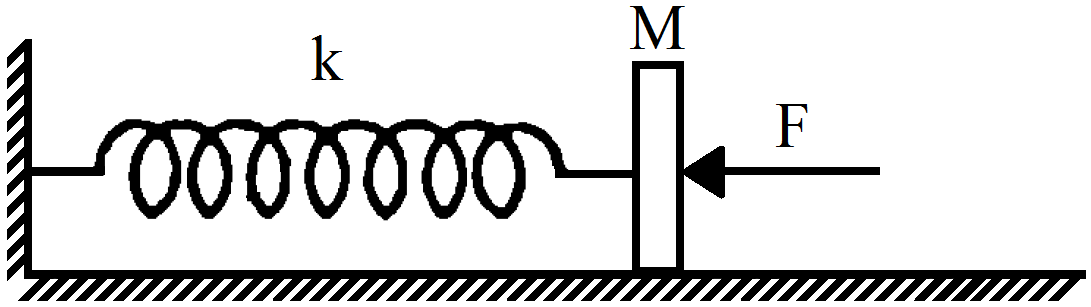
In figure k = 100N/m, M = 1kg and F = 10N,
  1. Find the compression of the spring in the equilibrium position.
  2. A sharp blow by some external agent imparts a speed of 2m/s to the block towards left. Find the sum of the potential energy of the spring and the kinetic energy of the block at this instant.
  3. Find the time period of the resulting simple harmonic motion.
  4. Find the amplitude.
  5. Write the potential energy of the spring when the block is at the left extreme.
  6. Write the potential energy of the spring when the block is at the right extreme.
The answers of (b), (e) and (f) are different. Explain why this does not violate the principle of conservation of energy.

Consider a non-conducting plate of radius r and mass m that has a charge q distributed uniformly over it. The plate is rotated about its axis with an angular speed $\omega.$ Show that the magnetic moment $\mu$ and the angular momentum of the plate are related as $\mu=\frac{\text{q}}{2\text{m}}\text{l}.$
A train, standing in a station-yard, blows a whistle of frequency 400Hz in still air. The wind starts blowing in the direction from the yard to the station with a speed of 10m s–1. What are the frequency, wavelength, and speed of sound for an observer standing on the station’s platform? Is the situation exactly identical to the case when the air is still and the observer runs towards the yard at a speed of 10m s–1? The speed of sound in still air can be taken as 340m s–1.
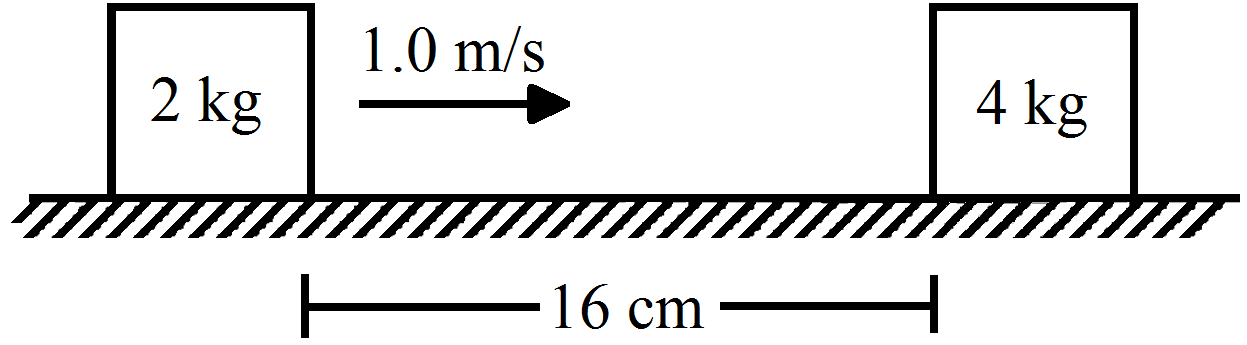
The friction coefficient between the horizontal surface and each of the blocks shown in figure is 0.20. The collision between the blocks is perfectly elastic. Find the separation between the two blocks when they come o rest. Take g = 10 m/s2.

  1. Discuss the motion of a body in a vertical circle. Find the expressions for the minimum velocity at the lowest and highest points while looping a loop.
  2. A bullet of mass 0.01kg travelling at a speed of 500m/ s strikes a block of mass 2kg which is suspended by a string of length 5m. The centre of gravity of the block is found to rise a vertical distance of 0.1 m. What is the speed of the bullet after it emerges from the block? (g = 9.8ms-2)
A rocket is fired from the earth towards the sun. At what distance from the earth's centre is the gravitational force on the rocket zero? Mass of the sun $=2 \times 10^{30} kg$, mass of the earth $=6 \times 10^{24} kg$. Neglect the effect of other planets etc. (orbital radius $\left.=1.5 \times 10^{11} m\right)$.
A particle on a stretched string supporting a travelling wave, takes 5.0ms to move from its mean position to the extreme position. The distance between two consecutive particles, which are at their mean positions, is 2.0cm. Find the frequency, the wavelength and the wave speed.