Question
Establish the expression for equivalent resistance of series combination and parallel combination of resistance separately.
Answer

(a) Resistances in series combination : "A number of resistors are said to be connected in series combination if they are connected end to end."
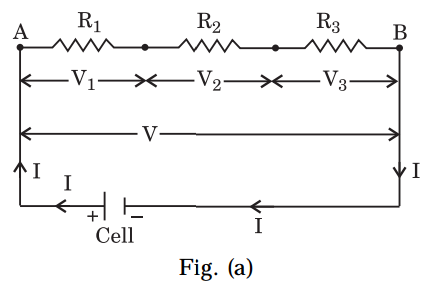
In this combination when some potential difference is applied across the ends of the combination the same current flows through each of the resistors. But potential difference across each of the resistors is different and the sum of the potential difference across the individual resistors is equal to the potential difference applied across the combination.
Image
In fig. (a) the series combination of three resistors having resistances $R _1, \quad R _2$ and $R _3$ is shown, when a potential difference V is applied across the ends A and B of the combination by connecting a cell between these points, let the current flowing through all the resistors be I. Suppose that the potential difference across the individual resistors of resistance $R _1, \ R _2$ and $R _3$ are $V _1, \  V _2$ and $V _3$ respectively. Then, according to Ohm's law,
$V _1= IR _1, V_2= IR _2$ and $V _3= IR _3$
Let the equivalent resistance of the combination be R, then according to Ohm's law,
V = IR.
But for series combination :
$V=V_1+V_2+V_3$
$\Rightarrow \quad IR = IR _1+ IR _2+ IR _3$
$\Rightarrow \quad R = R _1+ R _2+ R _3$
The same argument may be applied to the series combination of any number of resistors. Hence
$R = R _1+ R _2+ R _3+\ldots \ldots+ R _i \Rightarrow R =\sum_{i=1}^n R _i$
"Thus, equivalent resistance of series combination of any number of resistors is equal to the sum of their individual resistances and is always greater than the value of resistance of individual resistors."

Need a full question paper?

Generate a complete, print-ready paper with questions like this in minutes — across 16+ boards, with answer keys.

Start Generating Free

Similar questions

In a microwave oven, the food is kept in a plastic container and the microwave is directed towards the food. The food is cooked without melting or igniting the plastic container. Explain.
Power $(P)$ of a lens is given by reciprocal of focal length $(f)$ of the lens i.e. $\text{p}=\frac{1}{\text{f}},$ where $f$ is in metre and $P$ is in dioptre. For a convex lens, power is positive and for a concave lens, power is negative. When a number of thin lenses of powers $P_1, P_2, P_3, ......$ are held in contact with one another, the power of the combination is given by algebraic sum of the powers of all the lenses i.e., $P = P_1 + P_2 + P_3 +......$
  1. A convex and a concave lens separated by distance d are then put in contact. The focal length of the combination.
  1. Becomes $0.$
  2. Remains the same.
  3. Decreases.
  4. Increases.
  1. If two lenses of power $+1.5D$ and $+1.0D$ are placed in contact, then the effective power of combination will be.
  1. $2.5D$
  2. $1.5D$
  3. $0.5D$
  4. $3.25D$
  1. If the power of a lens is $+5$ dioptre, what is the focal length of the lens?
  1. $10\ cm$
  2. $20\ cm$
  3. $15\ cm$
  4. $5\ cm$
  1. Two thin lenses of focal lengths $+10\ cm$ and $-5\ cm$ are kept in contact. The power of the combination is:
  1. $-10D$
  2. $-20D$
  3. $10D$
  4. $15D$
  1. A convex lens of focal length $25\ cm$ is placed coaxially in contact with a concave lens of focal length $20\ cm.$ The system will be.
  1. Converging in nature.
  2. Diverging in nature.
  3. Can be converging or divergin.
  4. None of the above.
The magnetic field due to the earth has a horizontal component of $26\mu\text{T}$ at a place where the dip is 60°. Find the vertical component and the magnitude of the field.
Write difference between nuclear fission and radioactivity i.e. radioactive decay.
Two cations with equal charge repel each other with a force of $3.7 \times 10^{-9}$ Newton while the distance between them is $5 A$. How many electrons are less in each ion than in the normal state?
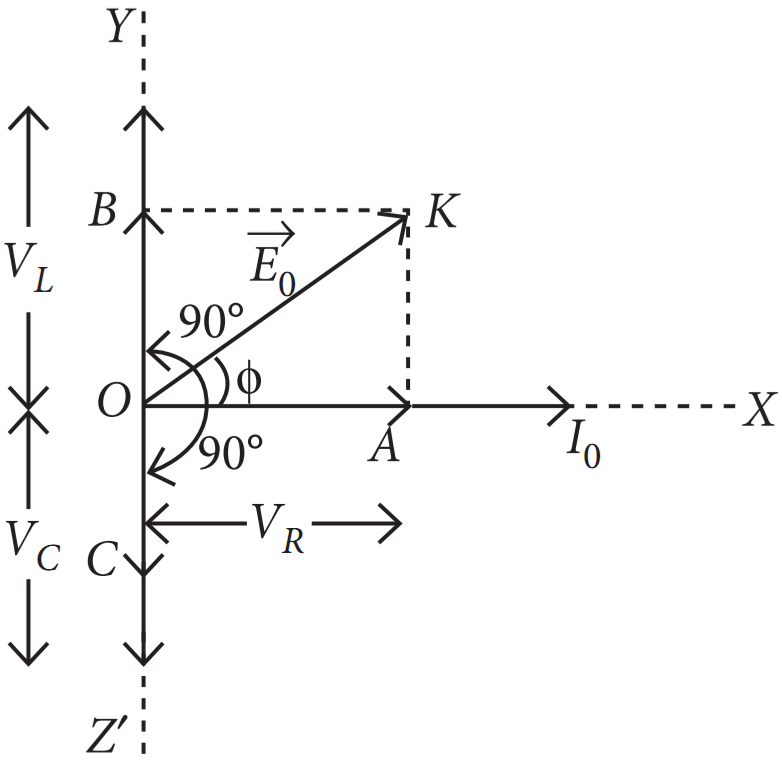
When a pure resistance $R,$ pure inductor $L$ and an ideal capacitor of capacitance $C$ is connected in series to a source of alternating $e.m.f.,$ then current at any instant through the three elements has the same amplitude and is represented as $\text{I} = \text{I}_0\sin\omega\text{t}.$ However, voltage across each element has a different phase relationship with the current as shown in graph. The effective resistance of $\ce{RLC}$ circuit is called impedance $(Z)$ of the circuit and the voltage leads the current by a phase angle $\phi.$

A resistor of $12\Omega,$ a capacitor ofreactance $14\Omega,$ and a pure inductor of inductance $0.1H$ are joined in series and placed across $200V, 50\ \ce{Hz} \ a.c.$ supply.
  1. The value of inductive reactance is:
  1. $15\Omega$
  2. $31.4\Omega$
  3. $20\Omega$
  4. $30\Omega$
  1. The value of impedance is:
  1. $20\Omega$
  2. $15\Omega$
  3. $30\Omega$
  4. $21.13\Omega$
  1. What is the value of current in the circuit?
  1. $5A$
  2. $15A$
  3. $10A$
  4. $9.46A$
  1. What is the value of the phase angle between current and voltage?
  1. $53^\circ 9\ '$
  2. $63^\circ 9\ '$
  3. $55^\circ 4\ '$
  4. $50^\circ$
  1. From graph, which one is true from following?
  1. $\ce{V_L \geq V_C}$
  2. $\ce{V_L < V_C}$
  3. $\ce{V_L < V_C}$
  4. $\ce{V_L < V_C}$
Cloudy nights are warmer than the nights with clean sky. Explain.
A lady cannot see objects closer than 40cm from the left eye and closer than 100cm from the right eye. While on a mountaineering trip, she is lost from her team. She tries to make an astronomical telscope from her reading glasses to look for her teammates.
  1. Which glass should she use as the eyepiece?
  2. What magnification can she get with relaxed eye?
Two long bar magnets are placed with their axes coinciding in such a way that the north pole of the first magnet is 2·0cm from the south pole of the second. If both the magnets have a pole strength of 10A-m, find the force exerted by one magnet on the other.
Draw a block diagram of a generalized communication system. Write the functions of each of the following:
(a) Transmitter, (b) Channel, (c) Receiver.