Question
Establish the following vector in equalities geometrically or otherwise :
(a) $|\vec{a}+\vec{b}| \leq|\vec{a}|+|\vec{b}|$
(b) $|\vec{a}+\vec{b}| \geq|\vec{a}|-|\vec{b}| \mid$
(c) $|\vec{a}-\vec{b}| \leq|\vec{a}|+|\vec{b}|$
(d) $|\vec{a}-\vec{b}| \geq|\vec{a}|-|\vec{b}| \mid$
When does the equality sign above apply?
Answer

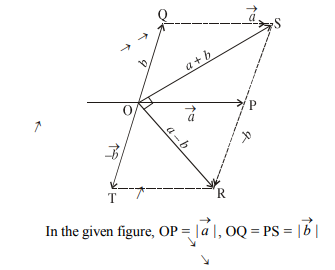
Consider two vectors $\vec{a}$ and $\vec{b}$ which are represented by $\overrightarrow{ OP }$ and $\overrightarrow{ OQ }$ two sides of parallelogram OPSQ. From the vector addition rule of parallelogram $(\vec{a}+\vec{b})$ is represented by the $\overrightarrow{ OS }$ vector.
Image
In the given figure, $OP =|\vec{a}|, OQ = PS =|\vec{b}|$
and $\quad OS =|\vec{a}+\vec{b}|$
(a) To prove : $|\vec{a}+\vec{b}| \leq|\vec{a}|+|\vec{b}|$
Proof : We know that in a triangle the length of one side is always less than the sum of lengths of the remaining two sides. Therefore in $\triangle OPS$ :
$OS < OP+PS$
$OS < OP+OQ$
$|\vec{a}+\vec{b}| <|\vec{a}|+|\vec{b}|\quad\quad...(1)$
If both the vectors are acting in the same direction along the same straight line, that is, they are collinear then,
$|\vec{a}+\vec{b}|=|\vec{a}|+|\vec{b}|\quad\quad...(2)$
From equations (1) and (2)
$|\vec{a}+\vec{b}| \leq|\vec{a}|+|\vec{b}|$
The equal sign applies only when the vectors are collinear and acting in the same direction.
Hence Proved.
(b) To prove : $|\vec{a}+\vec{b}| \geq \mid |\vec{a}|-|\vec{b}| \mid$
Proof : In a triangle, one side is greater than the difference between the other two sides. In $\triangle OPS$,
$OS+PS >OP $
$OS > |OP-PS| $
$OS >|OP-OQ| \quad\quad...(3)$
$\quad\quad\quad\therefore PS=OQ$
The modulus of ($OP - OQ$) has been taken, hence LHS will always be positive. But the value of RHS can also be engative if $OP < PS$.
Thus from equation (3),
$|\vec{a}+\vec{b}|> \mid |\vec{a}|-|\vec{b}| \mid\quad\quad...(4)$
If two vectors $\vec{a}$ and $\vec{b}$ are working in opposite directions along the same straight line, then
$|\vec{a}+\vec{b}|= \mid |\vec{a}|-|\vec{b}| \mid\quad\quad...(5)$
From equations (4) and (5)
$|\vec{a}+\vec{b}| \geq \mid |\vec{a}|-|\vec{b}| \mid$
Hence Proved.
(c) To prove : $|\vec{a}-\vec{b}| \leq|\vec{a}|+|\vec{b}|$
Proof : In $\triangle OPR$,
$OP=|\vec{a}|, PR=|-\vec{b}|=\vec{b}, OR=|\vec{a}-\vec{b}|$
From $\triangle OPR$,
$OR < OP+PR $
$|\vec{a}-\vec{b}| < |\vec{a}|+|\vec{b}|\quad\quad...(6)$
Now, vector $\vec{a}$ and $\vec{b}$ are in opposite directions along the same line then,
$|\vec{a}-\vec{b}|=|\vec{a}|+|\vec{b}|\quad\quad...(7)$
From equations (6) and (7)
$|\vec{a}-\vec{b}| \leq|\vec{a}|+|\vec{b}|$
Hence Proved.
(d) To prove : $|\vec{a}-\vec{b}| \geq \mid|\vec{a}|-|\vec{b}| \mid$
Proof : Since in any triangle one side is greater than the difference between the two sides then, in $\triangle OPR$,
$OP+PR > OP $
$OR > |OP-PR| $
$OR > |OP-OT|\quad\quad...(8)$
$\quad\quad\quad\because OT=PR$
Hence, modulus of (OP - OT) will always be positive. This means that the value of LHS will always be positive, but the value of RHS can also be negative if
$OP < OT$
Then from equation (8),
$|\vec{a}-\vec{b}|> \mid|\vec{a}|-|\vec{b}|\mid$ $\quad\quad...(9)$
If both vectors are in straight line and in same direction then,
$|\vec{a}-\vec{b}| = \mid|\vec{a}|-|\vec{b}|\mid$ $\quad\quad...(10)$
From equations (9) and (10)
$|\vec{a}-\vec{b}| \geq \mid|\vec{a}|-|\vec{b}|\mid$
Hence Proved.

Need a full question paper?

Generate a complete, print-ready paper with questions like this in minutes — across 16+ boards, with answer keys.

Start Generating Free

Similar questions

(vx, t),and(vy, t ) diagrams for a body of unit mass. Find the force as a function of time.

A disc of radius R is cut out from a larger disc of radius 2R in such a way that the edge of the hole touches the edge of the disc. Locate the centre of mass of the residual disc.
Figure is the plot of the stopping potential versus the frequency of the light used in an experiment on photoelectric effect. Find.

  1. The ratio h/e and.
  2. The work function.

A block of weight 100N is slowly slid up on a smooth incline of inclination 37° by a person. Calculate the work done by the person in moving the block through a distance of 2.0m, if the driving force is:
  1. Parallel to the incline.
  2. In the horizontal direction.
A container of volume 50cc contains air (mean molecular weight = 28.8g) and is open to atmosphere where the pressure is 100kPa. The container is kept in a bath containing melting ice (0°C).
  1. Find the mass of the air in the container when thermal equilibrium is reached.
  2. The container is now placed in another bath containing boiling water (100°C). Find the mass of air in the container.
  3. The container is now closed and placed in the melting-ice bath. Find the pressure of the air when thermal equilibrium is reached.
A ball is dropped and its displacement vs time graph is as shown Fig. (displacement x is from ground and all quantities are +ve upwards).
  1. Plot qualitatively velocity vs time graph.
  2. Plot qualitatively acceleration vs time graph.

A particle slides on the surface of a fixed smooth sphere starting from the topmost point. Find the angle rotated by the radius through the particle, when it leaves contact with the sphere.
A non-uniform bar of weight W is suspended at rest by two strings of negligible weight as shown in. The angles made by the strings with the vertical are 36.9° and 53.1° respectively. The bar is 2m long. Calculate the distance d of the centre of gravity of the bar from its left end.

A particle executes simple harmonic motion of amplitude A.
i. At what distance from the mean position is its kinetic energy equal to its potential energy?
ii. At what points is its speed half the maximum speed?
The difference between the two specific heat capacities (at constant pressure and volume) of a gas is 5000J kg-1 k-1 and the ratio of these specific heat capacities is 1.6. Find the two specific heat capacities i.e. Cp and Cv.