Question
Establish the following vector inequalities geometrically or otherwise: $|\text{a}-\text{b}|\ge||\text{a}|-|\text{b}||$When does the equality sign above apply?
Answer

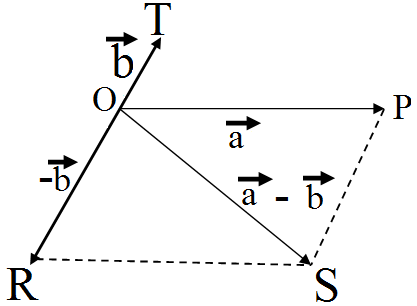
Let two vectors $\vec{\text{a}}$ and $\vec{\text{b}}$ be represented by the adjacent sides of a parallelogram PORS, as shown in the given figure. The following relations can be written for the given parallelogram. (OS + PS) > OP .....(i) OS < (OP - PS) .....(ii) $|\vec{\text{a}}-\vec{\text{b}}|>|\vec{\text{a}}|-|\vec{\text{b}}|\ ...(\text{iii})$ The quantity on the LHS is always positive and that on the RHS can be positive or negative. To make both quantities positive, we take modulus on both sides as: $||\vec{\text{a}}-\vec{\text{b}}||>||\vec{\text{a}}|-|\vec{\text{b}}||$ $|\vec{\text{a}}-\vec{\text{b}}|>||\vec{\text{a}}|-|\vec{\text{b}}||\ ...(\text{iv})$ If the two vectors act in a straight line but in opposite directions, then we can write: $|\vec{\text{a}}-\vec{\text{b}}|=||\vec{\text{a}}|-|\vec{\text{b}}||\ ...(\text{v})$ Combining equations (iv) and (v), we get: $|\vec{\text{a}}-\vec{\text{b}}|\ge||\vec{\text{a}}|-|\vec{\text{b}}||$

Need a full question paper?

Generate a complete, print-ready paper with questions like this in minutes — across 16+ boards, with answer keys.
Start Generating Free

Similar questions

Calculate the heat required to convert 0.6 kg of ice at $-20^{\circ} \mathrm{C}$, kept in a calorimeter to steam at $100^{\circ} \mathrm{C}$ at atmospheric pressure. Given the specific heat capacity of ice $=2100 \mathrm{~J} \mathrm{~kg}^{-1} \mathrm{~K}^{-1}$, specific heat capacity of water is $4186 \mathrm{~J} \mathrm{~kg}^{-1} \mathrm{~K}^{-1}$, latent heat of ice $=3.35 \times 10^5 \mathrm{~J} \mathrm{~kg}^{-1}$, and latent heat of steam $=2.256 \times 106 \mathrm{~J} \mathrm{~kg}^{-1}$.
An aluminium can of cylindrical shape contains $500cm^3$ of water. The area of the inner cross section of the can is $125cm^2$. All measurements refer to $10^\circ C$. Find the rise in the water level if the temperature increases to $80^\circ C$. The coefficient of linear expansion of aluminium = $23 \times {10^{-6}} { ^\circ C}^{-1}$ and the average coefficient of volume expansion of water = $3.2 \times {10^{-4}} { ^\circ C}^{-1}$ respectively.
Derive an equation for the distance covered by a uniformly accelerated body in $n^{th}$ second of its motion. A body travels half its total path in the last second of its fall from rest. Calculate the time of its fall.
The velocity of a body of mass 2kg as a function of t is given by $\text{v}(\text{t})=2\text{t}\hat{\text{i}}+\text{t}^2\hat{\text{j.}}$ Find the momentum and the force acting on it, at time $\text{t}=2\text{s}.$
Prove that from the surface of earth :
(i) accleration due to the gravity at a height $h$$
g_h=g\left(1-\frac{2 h}{ R }\right)
$(ii) Acceleration due to gravity at depth $h ^{\prime}$$
g_h^{\prime}=g\left(1-\frac{h^{\prime}}{ R }\right)
$
Where g is the gravitational acceleration on earth's surface and $R$ is the radius of the Earth. (Here assume $\rho$ and $h \ll R)$
A child running a temperature of $101°F$ is given an antipyrin (i.e. a medicine that lowers fever) which causes an increase in the rate of evaporation of sweat from his body. If the fever is brought down to $98°F$ in $20$ minutes, what is the average rate of extra evaporation caused, by the drug. Assume the evaporation mechanism to be the only way by which heat is lost. The mass of the child is $30kg$. The specific heat of human body is approximately the same as that of water, and latent heat of evaporation of water at that temperature is about $580cal\ g^{–1}$.
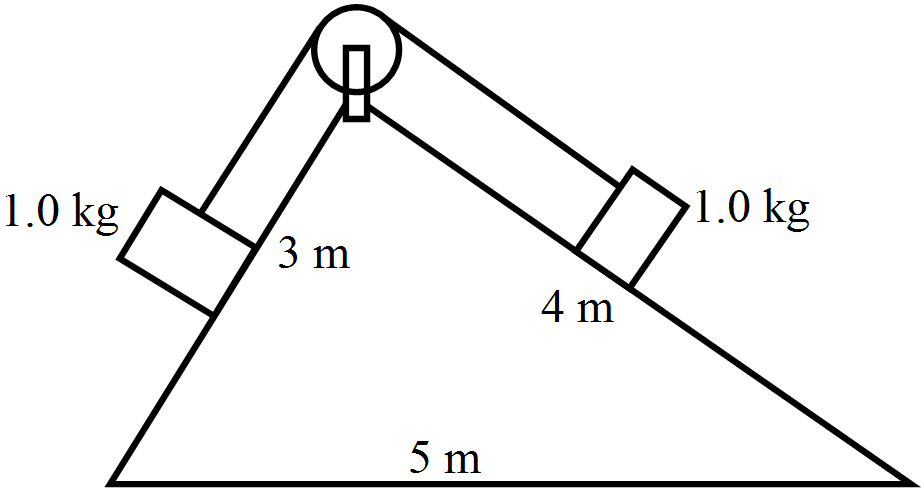
Consider the situation shown in figure. All the surfaces are frictionless and the string and the pulley are light. Find the magnitude of the acceleration of the two blocks.
Find the time period of small oscillations of the following systems.
  1. A metre stick suspended through the $20cm$ mark.
  2. A ring of mass in and radius r suspended through a point on its periphery.
  3. A uniform square plate of edge a suspended through a corner.
  4. A unifrom disc of mass m and radius r suspended through a point $\frac{\text{r}}{2}$ away from the centre.
Explain why A spinning cricket ball in air does not follow a parabolic trajectory.
A metre scale made of steel reads accurately at $20^\circ C$. In a sensitive experiment, distances accurate up to $0.055mm$ in $1m$ are required. Find the range of temperature in which the experiment can be performed with this metre scale. Coefficient of linear expansion of steel = $11 \times {10}^{-6}{^\circ C}^{-1}$.