Question
Establish the relationship between Gibbs energy change and equilibrium constant.
Generate a complete, print-ready paper with questions like this in minutes — across 16+ boards, with answer keys.
$\text{PCl}_5(\text{s})\rightleftharpoons\text{PCl}_3(\text{s})+\text{Cl}_2(\text{g});$
$\Delta_\text{r}\text{H}^\text{o}=124.0\text{kJ mol}^{-1}$
$\text{BaCO}_3(\text{s})\rightleftharpoons\text{BaO(s)}+\text{CO}_2(\text{g})$
$\text{CH}_4(\text{g})+2\text{O}_2(\text{g})\rightleftharpoons\text{CO}_2(\text{g})+2\text{H}_2\text{O(g)}$
| | Column I | | Column II |
| (i) | 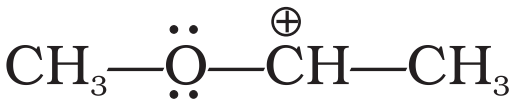 | (a) | Stable due to resonance. |
| (ii) | $\text{F}_3-\text{C}^\oplus$ | (b) | Destabilised due to inductive effect. |
| (iii) | $\ \ \ \ \ \ \ \ \ \ \ \ \text{CH}_3\\\ \ \ \ \ \ \ \ \ \ \ \ \ |\\\text{CH}_3-\text{C}^\ominus\\\ \ \ \ \ \ \ \ \ \ \ \ \ \ |\\\ \ \ \ \ \ \ \ \ \ \ \ \ \text{CH}_3$ | (c) | Stabilised by hyperconjugation. |
| (iv) | $\ \ \ \ \ \ \ \ \ \ \ \ \ _\oplus\\\text{CH}_3-\text{CH}-\text{CH}_3$ | (d) | A secondary carbocation. |