Question
Estimate the minimum potential difference needed to reduce Al2O3 at 500°C. The free energy change for the decomposition reaction,
$\frac{2}{3}\text{Al}_2\text{O}_3\frac{4}{3}\text{Al + O}_2\text{ is }960\text{kJ (F = 96500C mol}-1)$
Answer

$\text{Al}_2\text{O}_3(2\text{Al}^{3+}+3\text{O}^{2-})\xrightarrow{ \ \ \ \ \ }2\text{Al}+\frac{3}{2}\text{O}_2,\text{n}=6\text{e}^-$
$\therefore\frac{2}{3}\text{Al}_2\text{O}_3\xrightarrow{ \ \ \ \ \ \ \ }\frac{4}{3}\text{Al + O}_2,\text{n}=\frac{2}{3}\times6\text{e}^-=4\text{e}^-$
$\Delta_{\text{r}}\text{G}=960\times1000=960000\text{J}$
Now, $\Delta_{\text{r}}\text{G}=-\text{nFE}_{\text{cell}}$
$\Rightarrow\text{E}_{\text{cell}}=-\frac{\Delta_{\text{r}}\text{G}}{\text{nF}}=\frac{-960000}{4\times96500}$
$\Rightarrow\text{E}_{\text{cell}}=-2.487\text{V}$
$\therefore$ Minimum potential difference needed to reduce Al2O3 is -2.487V.

Need a full question paper?

Generate a complete, print-ready paper with questions like this in minutes — across 16+ boards, with answer keys.

Start Generating Free

Similar questions

Conductivity of saturated solution of $BaSO _4$ at 315 K is $3.648 \times 10^{-6} ohm ^{-1} cm^{-1}$ and that of water is $1.25 \times$ $10^{-6} ohm ^{-1} cm^{-1}$. Ionic conductance of $Ba ^{2+}$ and $SO _4^{2-}$ are 110 and $136.6 ohm ^{-1} cm^2 mol^{-1}$ respectively. Calculate the solubility of $BaSO _4$ in $g / L$.
Oxidation of ketones involves carboncarbon bond cleavage. Name the products formed on oxidation of 2, 5-dimethylhexan-3-one.
Following data are obtained for the reaction:
N2O5 $\rightarrow$ 2NO2 + ½O2
t/s 0 300 600
[N2O5]/mol L–1 1.6 × 10⁻² 0.8 × 10⁻² 0.4 × 10⁻²
  1. Show that it follows first order reaction.
  2. Calculate the half-life.
(Given log 2 = 0.3010 log 4 = 0.6021)
On the basis of the following data, explain why Co -(III) is not stable in aqueous solution? $
Co^{3+}+e^{-} \rightarrow Co^2+, E^0=+1.82 V
$
$
2 H_2 O \rightarrow O_2+4 H^{+}+4 e^{-}, E^0=1.23 V
$
Explain chemical properties of $KMnO _4$
(a) Write the IUPAC name of $\left[ K _4 Fe ( CN )_6\right]$
(b) Differentiate between the homoleptic and heteroleptic complexes.
(c) Draw the geometrical diagram of complex ion $\left( Co \left( NH _3\right)_6\right)^{3+}$
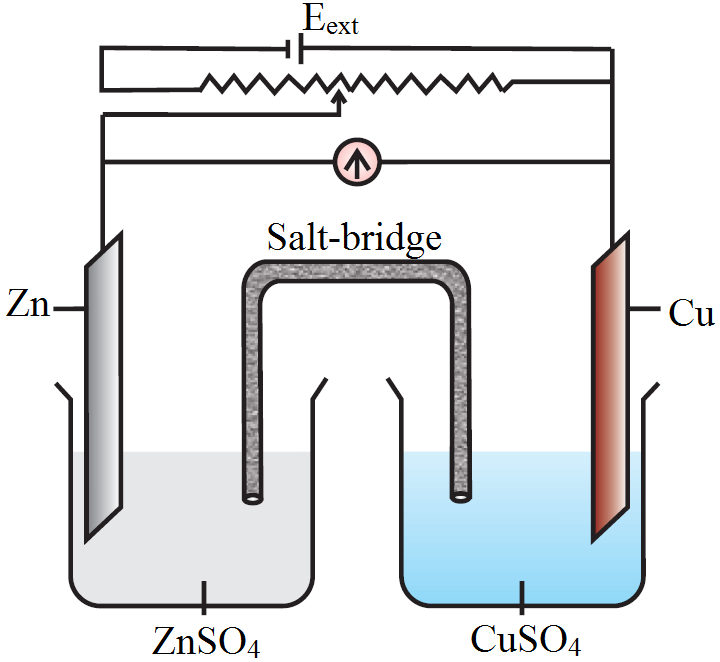
The electrochemical cell given alongside converts the chemical energy released during the redox reaction
$\text{Zn(s) + Cu}^{2+}\text{(aq)}\xrightarrow{ \ \ \ \ \ \ \ }\text{Zn}^{2+}(\text{aq) + Cu(s)}$
to electrical energy. It gives an electrical potential of 1.1V when concentration Zn2+ and Cu2+ ions is unity. State the direction of flow of current and also specify whether zinc and copper are deposited or dissolved at their respective electrodes when:
  1. An external opposite potential of less than 1.1V is applied.
  2. An external potential of 1.1V is applied.
  3. An external potential of greater than 1.1V is applied.

Write one chemical equation for each, to illustrate the following reactions:
  1. Rosenmund reduction.
  2. Cannizzaro reaction.
  3. Fischer esterification.
An aqueous solution of 2% non-volatile solute exerts a pressure of 1.004 bar at the normal boiling point of the solvent. What is the molar mass of the solute?
Two elements A and B form compounds having formula AB2 and AB4. When dissolved in 20 g of benzene (C6H6), 1 g of AB2 lowers the freezing point by 2.3 K whereas 1.0 g of AB4 lowers it by 1.3 K. The molar depression constant for benzene is 5.1 K kg mol–1. Calculate atomic masses of A and B.