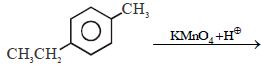
MCQ
Ethanol and $HCO_2H$ can't be distinguished by
  • A
    Tollen's reagent
  • Hot acidic $KMnO_4$ solution
  • C
    Fehling solution
  • D
    $HgCl_2$ solution

Answer

Correct option: B.
Hot acidic $KMnO_4$ solution
b

Need a full question paper?

Generate a complete, print-ready paper with questions like this in minutes — across 16+ boards, with answer keys.

Start Generating Free

Similar questions

The element which is the most abundant in the earth crust is
In the following sequence of reactions, the alkene affords the compound  $'B'$

$CH_3 - CH = CH - CH_3 \xrightarrow{{{O_3}}} A $$\xrightarrow[{Zn}]{{{H_2}O}} B.$

The compound $B$ is

Acetylene gas when passed through the $20\%$ ${H_2}S{O_4}{\rm{ \,at\, }}\,{80\,^o }C$ gives acetaldehyde. The catalyst required for this conversion is
Match the metal ions given in Column$- I$ with the spin magnetic moments of the ions given in Column$-II$ and assign the correct code

Column$-I$ Column$-II$
$(a)\;Co^{+3}$ $(i)\;\sqrt{8}\; B.M.$
$(b)\;Cr^{+3}$ $(ii)\;\sqrt{35}\; B.M.$
$(c)\;Fe^{+3}$ $(iii)\;\sqrt{3}\; B.M.$
$(d)\;Ni^{+2}$ $(iv)\;\sqrt{24}\; B.M.$
  $(v)\;\sqrt{15}\; B.M.$

$(a)\quad (b)\quad (c)\quad (d)$

What is the major product of the following reaction ?
The reagents with which glucose does not react to give the corresponding tests/products are

$A$. Tollen's reagent  $B$. Schiff's reagent $C$. $\mathrm{HCN}$ $D$. $\mathrm{NH}_2 \mathrm{OH}$ $E$. $\mathrm{NaHSO}_3$

Choose the correct options from the given below:
If $0.01 \,M$ solution of an electrolyte has a resistance of $40 \,ohms$ in a cell having a  cell constant of $0.4\,cm^{-1}$ then its molar conductance in $ohm^{-1}\, cm^2 \,mol^{-1}$ will be :-
For a first order reaction $A \to B$, the reaction rate at reactant concentration of $0.01\, M$ is found to be $2.0\times10^{-5}\, M\, sec^{-1}$. The half life period of the reaction is .......... $\sec$
Calculate the enthalpy change when $50\,ml$ of $0.01\, M \,Ca(OH)_2$ reacts with $25\,ml$ of $0.01\, M\, HCl.$ Given that $\Delta H^o $ for neutralisation of a strong acid and a strong base is $140\, k\,cal\, mol^{-1}$ .........$kcal$
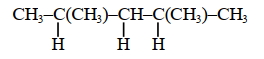
In the given compound, the number of $2^{\circ}$ carbon atom $/ \mathrm{s}$ is. . . . . .