MCQ
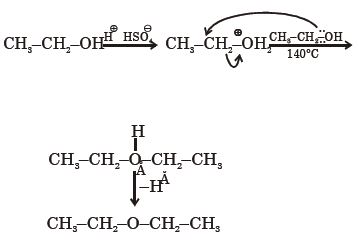
Ethanol reacts with $H_2SO_4$ at $140^o$ to form
  • A
    Ethene
  • B
    Ethyl hydrogen sulphate
  • Ethoxy ethane
  • D
    None of these

Answer

Correct option: C.
Ethoxy ethane
c

Need a full question paper?

Generate a complete, print-ready paper with questions like this in minutes — across 16+ boards, with answer keys.
Start Generating Free

Similar questions

The product formed by the reaction of chlorine with benzaldehyde in the absence of a catalyst is
Starting from propanoic acid the following reactions were carried out as following $CH_3 - CH_2 - COOH$ $\xrightarrow{{SOC{l_2}}}\left[ X \right]\xrightarrow[\Delta ]{{N{H_3}}}\left[ Y \right]\xrightarrow[{KOH}]{{B{r_2}}}\left[ Z \right]$ Product $[Z]$ will be?
The volume of water which must be added to $40\,cc$ of $0.25\,M$ oxalic acid solution to make it exactly decimolar $(0.1\,M)$ is ....... $cc$.
Cyanohydrin of which compound on hydrolysis will give lactic acid?
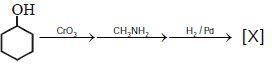
Product $[X]$ of given reaction is
For a zero - order reaction,
Potassium chlorate is prepared by electrolysis of $\mathrm{KCl}$ in basic solution as shown by following equation.

$6 \mathrm{OH}^{-}+\mathrm{Cl}^{-} \rightarrow \mathrm{ClO}_{3}^{-}+3 \mathrm{H}_{2} \mathrm{O}+6 \mathrm{e}^{-}$

A current of $x A$ has to be passed for $10 h$ to produce $10.0 \mathrm{~g}$ of potassium chlorate. The value of $\mathrm{x}$ is $.......$ (Nearest integer)

(Molar mass of $\left.\mathrm{KClO}_{3}=122.6 \mathrm{~g} \mathrm{~mol}^{-1}, \mathrm{~F}=96500 \mathrm{C}\right)$

Which of the following compound gives secondary amine on reduction?
For the following Assertion and Reason, the correct option is

Assertion : For hydrogenation reactions, the catalytic activity increases from Group $5$ to Group $11$ metals with maximum activity shown by Group $7-9$ elements.

Reason : The reactants are most strongly adsorbed on group $7-9 $ elements.

Which one of the following statement is true for transition elements