MCQ
Ethanol reacts with sodium and forms two products. These are :
  • A
    Sodium ethanoate and hydrogen.
  • B
    Sodium ethanoate and oxygen.
  • Sodium ethoxide and hydrogen.
  • D
    Sodium ethoxide and oxygen.

Answer

Correct option: C.
Sodium ethoxide and hydrogen.
$2\text{C}_2\text{H}_5\text{OH}+2\text{Na}\rightarrow2\text{C}_2\text{H}_5\text{ONa + H}_2$
$\ \ \ \ \ \ \ \ \ \ \ \ \ \ \ \ \ \ \ \ \ \ \ \ \ \ \ \ \ \ \ \ \ \text{Sod.ethoxide}$​​​​​​​

Need a full question paper?

Generate a complete, print-ready paper with questions like this in minutes — across 16+ boards, with answer keys.
Start Generating Free

Similar questions

An element $X$ combines with oxygen to form an oxide $XO.$ This oxide is electrically conducting. Write the formula of the compound formed when $X$ reacts with chlorine.
The least reactive metal among the following is :
A student determines the focal length of a device $'X\ ’$ by focusing the image of a distant object on a screen placed $20\ cm$ from the device on the same side as the object. The device $'X\ ’$ is.
Hard water is not available for an experiment. Some salts are given below:
  1. Sodium chloride.
  2. Sodium sulphate.
  3. Calcium chloride.
  4. Calcium sulphate.
  5. Potassium chloride.
  6. Magnesium sulphate.
Select from the following a group of these salts, each member of which may be dissolved in water to make it hard.
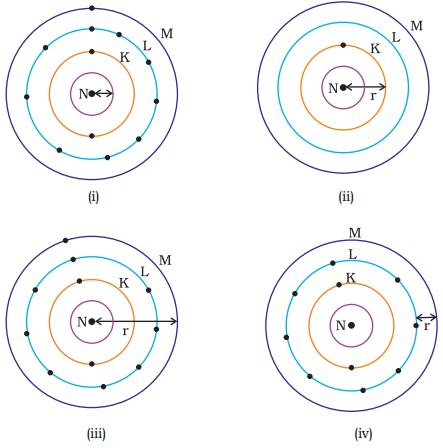
Which one of the following depict the correct representation of atomic radius $(r)$ of an atom?
A $ ........... $ is a long, ribbon like waterway that flows toward the ocean :
Which of the following are the characteristics of isotopes of an element?
  1. Isotopes of an element have same atomic masses.
  2. Isotopes of an element have same atomic number.
  3. Isotopes of an element show same physical properties.
  4. Isotopes of an element show same chemical properties.
The number of pair $(s)$ of sex chromosomes in the zygote of humans is :
On the basis of the sequence of the given reactions identify the most and least reactive elements :
$\ce{X + YA \rightarrow XA + Y ...(i) , X + YB \rightarrow XB + Y ...(ii) , Z + XA \rightarrow ZA + X}$
Which of the following pair of reactants can undergo a displacement reaction under appropriate conditions?