MCQ
Ethephon
  • A
    Hasten fruit ripening in tomatoes
  • B
    Accelerate abscission
  • C
    Promote female flower cucumbers
  • All of the above

Answer

Correct option: D.
All of the above
d
Ethepton hastens fruit ripening in tomatoes and apples and accelerates abscission in flowers and fruits. It promotes female flowers in cucumbers thereby increasing the yield

Need a full question paper?

Generate a complete, print-ready paper with questions like this in minutes — across 16+ boards, with answer keys.

Start Generating Free

Similar questions

Plant classification proposed by Carolus Linnaeus was artificial because it was based on
The most abundant prokaryotes helpful to humans in making curd from milk and in production of antibiotics are the ones categorised as :
Trans face of golgi bodies........
Which one of the following statements concerning the algae is wrong
In following which are examples of commensalism ?

$(1)$ Monarch butterfly and bird

$(2)$ Orchid and mango

$(3)$ Fish and flamingo

$(4)$ Calotropis and cattle

$(5)$ Cattle egret and grazing cattle

$DNA$ replicates
Consider the following four statements $(i), (ii),(iii)$ and $(iv)$ and select the right option for two correct statements.

Statements :

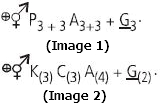
$(i)$ In vexillary aestivation, the large posterior petal is called­standard, two lateral ones are wings and two small anterior petals are termed keel.

$(ii)$ The floral formula for Liliaceae is (image 1)

$(iii)$ Inpeaflowerthestamensare monadelphous.

$(iv)$ The floral formula for Solanaceae is (image 2)

The correct statements are
Which of the following components provides sticky character to the bacterial cell?
What is absent in $DNA$?
Given below are two statements, one is labelled as Assertion (A) and the other is labelled as Reason (R).
Assertion (A):
In angiosperm the viability period of pollen grain is highly variable.
Reason (R):
In some cereals such as rice and wheat, pollen grains lose viability within 30 minutes of their release and in some members of Rosaceae, Leguminoseae and Solanaceae, They maintain viability for months.
In the light of the above statements, choose the most appropriate answer from the options given below: