MCQ
Ethyl acetate reacts with $C{H_3}MgBr$ to form
  • A
    Secondary alcohol
  • Tertiary alcohol
  • C
    Primary alcohol and acid
  • D
    Acid

Answer

Correct option: B.
Tertiary alcohol
b
$\underset{Ethyl\,\,acetate}{\mathop{\begin{matrix}
   \,O  \\
   \,||  \\
   C{{H}_{3}}C-C-{{C}_{2}}{{H}_{5}}  \\
\end{matrix}}}$ $+\,C{{H}_{3}}MgBr\,\to $ $\begin{array}{*{20}{c}}
  {\begin{array}{*{20}{c}}
  {\,\,\,\,\,\,\,\,\,\,O - MgBr} \\ 
  {|\,\,\,\,\,\,\,\,\,\,\,\,\,\,} 
\end{array}} \\ 
  {C{H_3} - C - O - {C_2}{H_5}} \\ 
  {|\,\,\,\,\,\,\,\,\,\,\,\,\,\,} \\ 
  {C{H_3}\,\,\,\,\,\,\,} 
\end{array}$  $\xrightarrow[{ - \,Mg\, < \,\begin{array}{*{20}{c}}
  {Br} \\ 
  {OH} 
\end{array}}]{{ + \,{H_2}O}}$ $\begin{array}{*{20}{c}}
  {\begin{array}{*{20}{c}}
  {\,\,\,\,\,\,\,OH} \\ 
  | 
\end{array}} \\ 
  {C{H_3} - C - OH} \\ 
  | \\ 
  {\,\,\,\,\,\,\,\,\,C{H_3}} 
\end{array}$ $\xrightarrow{{ - \,{H_2}O}}$ $\begin{array}{*{20}{c}}
  O \\ 
  {||} \\ 
  {C{H_3} - C - C{H_3}} 
\end{array}$ $\xrightarrow[{C{H_3}MgBr}]{{Excess\,\,of}}$ $\begin{array}{*{20}{c}}
  {\begin{array}{*{20}{c}}
  {C{H_3}\,\,} \\ 
  {|\,\,\,\,\,\,\,\,} 
\end{array}} \\ 
  {C{H_3} - C - OMgBr} \\ 
  {\,\,|\,\,\,\,\,\,\,\,\,\,} \\ 
  {C{H_3}\,} 
\end{array}$ $\xrightarrow{{{H_2}O}}$ $\mathop {\begin{array}{*{20}{c}}
  {\begin{array}{*{20}{c}}
  {\,\,\,\,\,C{H_3}} \\ 
  | 
\end{array}} \\ 
  {C{H_3} - C - OH} \\ 
  {\,\,|} \\ 
  {\,\,\,\,\,\,\,\,\,\,C{H_{3.}}} 
\end{array}}\limits_{t\, - \,Butanol} $

Need a full question paper?

Generate a complete, print-ready paper with questions like this in minutes — across 16+ boards, with answer keys.
Start Generating Free

Similar questions

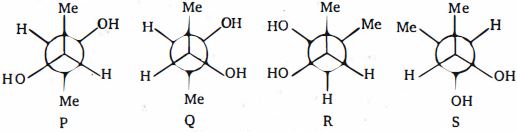
Among the following, the Newmann projections of meso- $2, 3$ -butanediol are
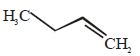
(image) $\xrightarrow[CC{{l}_{4}}]{HCl}X\xrightarrow{Aq.NaOH}Y\xrightarrow[\Delta ]{Conc.{{H}_{3}}P{{O}_{4}}}Z$ Major product is
The energy is lowest for the orbital :
Penetration power of proton is
When $2-$ butyne is treated with $H_2/$ Lindlar's catalyst, compound $X$ is produced as the major product and when treated with $Na/liq.$ $NH_3$ it produces $Y$ as the major product. Which of the following statements is correct?
When enthalpy and entropy change for a chemical reaction are $ - 2.5\, \times {10^3}\,cal$ and $7.4\,cal$ ${\deg ^{ - 1}}$ respectively. Predict the reaction at $298\,K$ is
A pure sample of nitrogen is prepared by heating
Which of the following will have standard oxidation potential less than $SHE$
The number of endothermic process/es from the following is

$A.$ $I _2( g ) \rightarrow 2 I ( g )$

$B.$ $HCl ( g ) \rightarrow H ( g )+ Cl ( g )$

$C.$ $H _2 O ( l ) \rightarrow H _2 O ( g )$

$D.$ $C ( s )+ O _2( g ) \rightarrow CO _2( g )$

$E.$ Dissolution of ammonium chloride in water

The energies of activation for forward and reverse reactions for $A_2 + B_2 \rightleftharpoons  2AB$ are $180\, kJ\, mol^{-1}$ and $200 \,kJ\, mol^{-1}$  respectively. The presence of a catalyst lowers the activation energy of both (forward and reverse) reactions by $100\, kJ\,mol^{-1}.$ The enthalpy change of the reaction $(A_2 + B_2 \rightarrow 2AB)$ in the presence of a catalyst will be ( in $kJ\, mol^{-1}$)