MCQ
Ethyl bromide can be converted into ethyl alcohol by
  • A
    Heating with dilute hydrochloric acid and zinc
  • B
    Boiling with an alcoholic solution of   $KOH$
  • The action of moist silver oxide
  • D
    Refluxing methanol

Answer

Correct option: C.
The action of moist silver oxide
c
(c) $A{g_2}O + {H_2}O \to 2AgOH$

${C_2}{H_5}Br + AgOH \to {C_2}{H_5}OH + AgBr$

Need a full question paper?

Generate a complete, print-ready paper with questions like this in minutes — across 16+ boards, with answer keys.

Start Generating Free

Similar questions

What is the product formed in the following reaction

${{C}_{6}}{{H}_{5}}OH+CC{{l}_{4}}\underset{(2)\,\,{{H}^{+}}}{\mathop{\xrightarrow{(1)\,\,NaOH}}}\,$
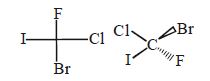
What is relation between following molecules
The correct relationship between the boiling points of very dilute solutions of $AlC{l_3}\,({t_1})$ and $CaC{l_2}\,({t_2})$, having the same molar concentration is
Identify the $D$ and $E$ in the following reaction

$\begin{array}{*{20}{c}}
  {C{H_3} - CH - CH - C{H_3}\xleftarrow[{ether}]{{Na}}R\,' - Br\,\xrightarrow{{Mg}}'D'\,\xrightarrow{{{H_2}O}}E} \\ 
  {\,\,\,\,|\,\,\,\,\,\,\,\,\,\,\,\,\,|\,\,\,\,\,\,\,\,\,\,\,\,\,\,\,\,\,\,\,\,\,\,\,\,\,\,\,\,\,\,\,\,\,\,\,\,\,\,\,\,\,\,\,\,\,\,\,\,\,\,\,\,\,\,\,\,\,\,\,\,\,\,\,\,\,\,\,\,\,\,\,\,\,\,\,\,\,\,\,\,\,\,\,\,\,\,\,} \\ 
  {\,\,\,\,\,C{H_3}\,\,\,\,\,C{H_3}\,\,\,\,\,\,\,\,\,\,\,\,\,\,\,\,\,\,\,\,\,\,\,\,\,\,\,\,\,\,\,\,\,\,\,\,\,\,\,\,\,\,\,\,\,\,\,\,\,\,\,\,\,\,\,\,\,\,\,\,\,\,\,\,\,\,\,\,\,\,\,\,\,\,\,\,\,\,\,\,\,\,\,} 
\end{array}$

Which of the following is known as inorganic benzene
A transition metal ' $\mathrm{M}$ ' among $\mathrm{Sc}, \mathrm{Ti}, \mathrm{V}, \mathrm{Cr}, \mathrm{Mn}$ and $\mathrm{Fe}$ has the highest second ionisation enthalpy. The spin only magnetic moment value of $\mathrm{M}^{+}$ion is. . . . . . .$\mathrm{BM}$ (Near integer)

(Given atomic number $\mathrm{Sc}: 21, \mathrm{Ti}: 22, \mathrm{~V}: 23, \mathrm{Cr}$ : $24, \mathrm{Mn}: 25, \mathrm{Fe}: 26)$

Which of the following reaction does not give primary amine as a product ?
Order of liquification of noble gases is
Arrange the following molecules from most to least polar 
$I$ , $II$ , $III$ , $IV$ , $V$ respectively
$CH_4$ , $CF_2Cl_2$ , $CF_2H_2$ , $CCl_4$ , $CCl_2H_2$
The solubility of $PbI_2$ at $25\,^oC$ is $0.7\, g\, L^{-1}$ . The solubility product of $PbI_2$ at this temperature is (molar mass of $PbI_2\, = 461.2\, g\, mol^{-1}$ )